Your encryption is already broken.
You just don't know it yet.
You have until 2030 to transition to post-quantum cryptography. ANKASecure© is the Crypto Agility Orchestration Platform that makes it a policy change — not a code rewrite. Four years is enough time, if you start now.

What do you need to solve first?
- Crypto-Agility
- Post-Quantum Migration
- Enterprise Cryptographic Control
- Legacy Cryptography Modernization
- Governed Third-Party Exchange
- Sovereign Key Custody
- Digital Signatures & Long-Term Evidence
Crypto-Agility. Change the algorithm without changing the application See how
THE REGULATORY CLOCK IS RUNNING
Deadlines are coming. Your release cycle is not faster.
The agencies have published their timelines, and the first penalties have already been issued. Every date below links to its primary source.
NIST publishes FIPS 203, 204 and 205
The post-quantum standards are final. The argument that the industry is waiting for a standard no longer exists.
Primary source↗NIS2 and DORA liability
NIS2 had to be transposed by 17 October 2024 and enforcement has already begun in Germany, the Netherlands and France; DORA has applied since 17 January 2025. Essential entities face up to EUR 10M or 2% of global turnover, whichever is higher.
Primary source↗EU — national roadmaps and pilots
Every Member State is expected to have a national post-quantum transition roadmap and pilots running for high and medium-risk use cases. This is the next real deadline, and it is European.
Primary source↗CNSA 2.0 — acquisitions
Every new acquisition of National Security Systems equipment must be CNSA 2.0 compliant by default. Support and preference for CNSA 2.0 come first, by dates that vary from 2025 to 2030 with the category of equipment; exclusive use follows later.
Primary source↗Where the timelines converge
In a draft (IR 8547), NIST deprecates RSA-2048 after 2030 and disallows it and the other quantum-vulnerable public-key algorithms after 2035; the EU expects high-risk use cases migrated by the end of 2030, medium-risk ones by the end of 2035, and low-risk ones as far as feasible by 2035; CNSA 2.0 requires exclusive use in software signing and networking by 2030, and in browsers, servers, cloud and operating systems by 2033.
Primary source↗FEAR #2 — THE BREACH ALREADY HAPPENED
Your encrypted data is already stolen.
Adversaries collect TLS traffic today. They decrypt it the moment they have a quantum computer. Your deal flow, patient records, and infrastructure comms are already at risk.
of enterprises
have no inventory of where RSA keys are deployed across their stack.
average TLS dwell time
the typical window adversaries need to retain encrypted traffic before a viable quantum decryptor exists.
data categories at risk
PHI, PII and NPI — all regulated, all collectible today, all decryptable at Q-Day.
Rewrite cryptography every 5 years — or govern it once, for decades.
ANKASecure© is the cryptographic Control Plane. Define your security policy once. We enforce it across every application — for as long as your data must stay safe.
PQC is the entry. Long-term cryptographic governance — for as long as your data lives — is the real value.
CAPA — Your Crypto Agility Posture
CAPA tells you where you stand and what you must be capable of changing — across six maturity levels. It is the framework that turns "are we ready?" into a roadmap.
- 1
Crypto-Agility
Change algorithms without modifying applications.
- 2
Cryptographic Sovereignty
Maintain full control over keys, policies and execution environments.
- 3
Frictionless Modernization
Migrate legacy systems without disruption or plaintext exposure.
- 4
Cryptographic Governance & Compliance
Your policy, defined by your team and enforced by ANKASecure© across every application at runtime — with signed evidence that it applied. Regulatory alignment lives in this pillar.
- 5
Enterprise Readiness
Your HSM or KMS stays the Root of Trust; your identity provider, SIEM and observability backend stay authoritative. Nothing you already run is replaced.
ANKASecure© — The Cryptographic Control Plane
ANKASecure© operationalizes CAPA. It sits between your applications and cryptographic execution, enforcing your policy across the full crypto lifecycle — for years, not for a single migration.
ANKASecure© enforces your policy at runtime:
- —Algorithm family
- —Hybrid composition
- —Key lifecycle
- —Policy constraints
- —Jurisdictional rules
One policy. Every algorithm. Every year ahead.
Solutions
Start with the problem that has a date on it. The rest is already installed.
Crypto-agility, post-quantum migration, cryptographic control, legacy archives, third-party access, key custody, long-lived signatures — seven things a CISO gets asked for, each demonstrable in fifteen minutes, all on one ANKASecure© installation.
INTEGRATIONS
It plugs into the stack you already run.
Your HSM, your cloud KMS, your directory, your SIEM, your observability backend. 45 systems across eight categories, 25 of them exercised end to end against the real vendor product.
A REAL DEPLOYMENT
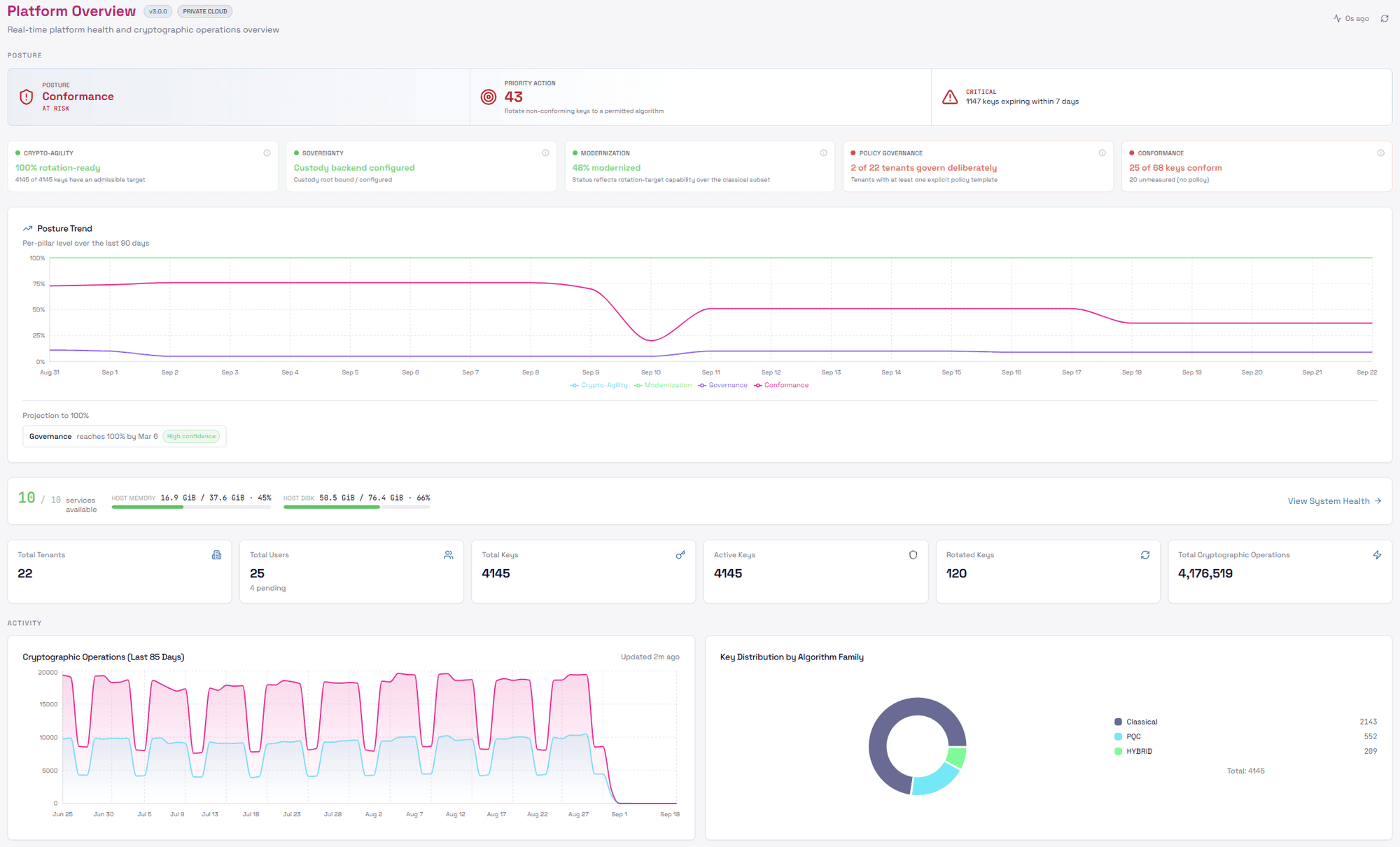
This is the console, not an illustration.
One ANKASecure© deployment governing 22 tenants and 4,145 keys, with 4.1 million cryptographic operations behind it. The posture is red because the estate it measures has work to do — that is the console doing its job, not a mock-up doing its best.
Federal agencies must migrate off RSA and ECC.
Data captured today can be decrypted when a CRQC is available.
One Control Plane across regulator changes, algorithm waves, and the full lifespan of your data.
Data encrypted today with classical algorithms may be harvested now and decrypted when a cryptographically-relevant quantum computer becomes available.
WHY ANKATECH
Three things that change everything about your crypto stack.
Zero-code migration. Cryptographic governance with evidence. 14+ international standards in one platform. These are the capabilities that make ANKASecure© different
Drop-in Migration
Swap RSA / ECC for NIST-standardised post-quantum primitives without rewriting your applications.
Cryptographic governance
Change this policy. Watch every operation migrate. Zero code changes.
Global Standards Coverage
14+ international standards. One platform.
Post-quantum cryptography, answered
What is post-quantum cryptography and why does it matter now?
How do I migrate to post-quantum cryptography without changing my applications?
What is the easiest way to add quantum-safe encryption via API?
Do my keys ever leave my infrastructure?
Can I keep my existing HSM, KMS, SIEM and identity provider?
What happens when an algorithm is broken or a standard changes?
Which vendors offer PQC solutions with support for multiple international standards?
Can I try it?
Evaluation runs in a guided sandbox: request access and ANKATech provisions an environment with credentials and an onboarding session.
Request access→Which of thesesounds like you?
Executive
CISO · CTO · CIO · Board
Your board is asking about quantum risk. Regulators are moving. Start with a 5-question PQC Risk Assessment, then explore the CAPA Maturity Model to quantify your exposure and build your board-ready action plan.
Take the PQC Risk AssessmentDeveloper
Security Architect · DevOps · Platform Engineer
Add post-quantum cryptography to any application in under 15 minutes. REST API, Java SDK, and three guided sandbox labs — no cryptography expertise required.
Request sandbox accessPartner
VAD · Channel · Investor
The post-quantum market is accelerating across North America, Europe, and Asia-Pacific. First-mover advantage, co-branded sandbox, PoC-in-a-Box, and a certification program to close deals autonomously.
Join the partner program