Post-quantum cryptography: the future is now
Gartner elevated post-quantum cryptography and cryptographic agility to a top cybersecurity trend for 2026. Why the threat is already active, what crypto-agility actually requires, and how to start without waiting for a complete cryptographic inventory.
Gartner elevated post-quantum cryptography and cryptographic agility to a top cybersecurity trend for 2026. This is not about distant threats. The danger is immediate, through "harvest now, decrypt later" attacks: adversaries are already intercepting and storing encrypted data today, knowing they will be able to decrypt it once quantum computers become powerful enough.
The quantum threat is active today
If your organization encrypts customer data using RSA-2048, that data could be readable to attackers in 2029 or 2030.
Regulatory frameworks are beginning to address this liability. Under the EU's NIS2 Directive, effective October 2024, organizations face fines of up to €10 million or 2% of global annual turnover for failing to prepare for known cryptographic threats.
What crypto-agility actually means
Crypto-agility isn't just adopting new algorithms. It is the ability to migrate between cryptographic methods without operational disruption or security gaps. Gartner identifies three critical capabilities:
Discover where cryptography is deployed across your infrastructure. Most organizations have no visibility into embedded cryptographic functions across applications, cloud services, IoT devices and legacy systems.
Assess which encrypted data carries the highest risk. Healthcare records and financial data require different protection strategies than cached web content.
Migrate between algorithms safely. Traditional approaches decrypt to plaintext, creating exposure windows. Modern crypto-agility platforms perform atomic re-encryption — moving data directly from one encrypted state to another without ever touching disk.
Why organizations are unprepared
Four critical failures prevent most enterprises from achieving crypto-agility.
Invisible cryptography. Organizations don't know where encryption happens across their infrastructure. Developers embed cryptographic libraries directly into applications with no centralized visibility.
Architectural rigidity. Legacy systems hard-code algorithm choices deep in application logic. Changing encryption requires application rewrites, not configuration updates. Organizations with hundreds of applications face years of development work.
Manual processes that don't scale. Successful migrations often rely on heroic, one-off efforts. Crisis-driven cryptographic migrations cost 3–5x more than planned, incremental approaches.
Viewing migration as a one-time project. Organizations need systems architected to handle algorithm transitions repeatedly and safely, not just a single post-quantum swap.
The technical requirements for true crypto-agility
Achieving what Gartner describes requires specific architectural capabilities.
Cryptographic abstraction. Applications interact with encryption through well-defined APIs that separate implementation from business logic. Changing from RSA to any other algorithm should happen at the platform level, without modifying applications.
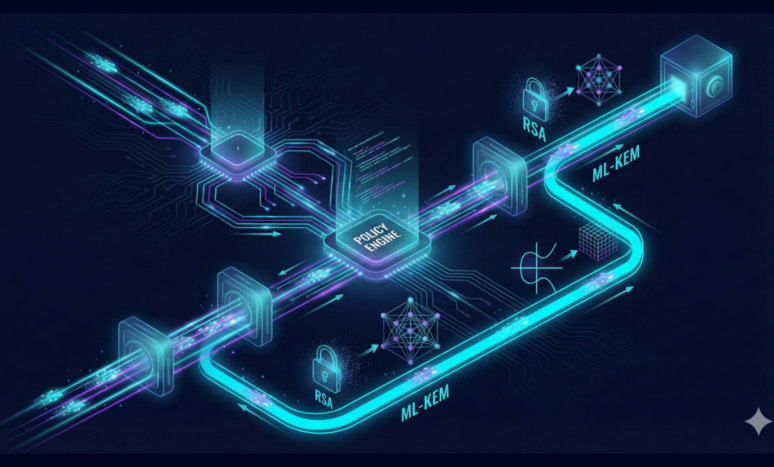
Policy-driven automation. Define cryptographic policies that automatically enforce algorithm selection based on data classification, compliance requirements, regulatory jurisdiction and threat level. When policies change, enforcement propagates across the infrastructure.
Safe migration capabilities. Advanced platforms perform atomic re-encryption operations, where data moves directly from one encrypted state to another. Plaintext never exists outside secure memory enclaves, and operations are all-or-nothing: if something fails, data remains securely encrypted with the original algorithm.
Performance at scale. Cryptographic operations are computationally intensive. Enterprise-scale migrations require architecture innovations that sustain high volumes of concurrent cryptographic operations on standard server hardware.
Comprehensive algorithm support. Support not just NIST's post-quantum standards — ML-KEM, ML-DSA and SLH-DSA — but also classical algorithms still in wide use, international alternatives from ANSSI (France), BSI (Germany) and CRYPTREC (Japan), and emerging standards.
ANKASecure© delivers what Gartner recommends
"Post-quantum cryptography is reshaping cybersecurity strategies by prompting organizations to identify, manage and replace traditional encryption methods, while prioritizing cryptographic agility."
— Alex Michaels, Director Analyst at Gartner, Cybersecurity Trend #3 for 2026
ANKASecure© was built specifically to provide the crypto-agility Gartner identifies as essential. The platform supports 120+ cryptographic algorithms spanning post-quantum standards and classical methods, aligned with 14+ international standards. More importantly, it enables safe, automated migration between algorithms.
Atomic re-encryption. When migrating data from one algorithm to another, the operation happens in a single transaction within isolated memory enclaves. Plaintext exposure is eliminated entirely.
Policy engine. Define cryptographic requirements based on data type, regulatory jurisdiction and compliance framework. French customer data automatically uses ANSSI-approved algorithms; US government contract data uses NIST standards. All managed through unified policies, without manual intervention.
Multi-standard support. ANKASecure© supports 14+ international cryptographic standards, enabling organizations to meet regional compliance requirements automatically.
Enterprise performance. A virtual thread architecture makes petabyte-scale migrations practical on standard server hardware.
Getting started with crypto-agility
Identify and prioritize in parallel. Complete cryptographic inventories cause analysis paralysis. Instead, start by identifying your highest-risk encryption points: systems handling sensitive data — healthcare records, financial information, intellectual property — or systems subject to compliance requirements such as HIPAA, GDPR and NIS2. Don't wait for 100% visibility across all applications, IoT devices and embedded systems before taking action. Modern crypto-agility platforms like ANKASecure© work best when you start with high-impact targets and expand iteratively.
Execute assessment, evaluation and pilots simultaneously. While identifying critical systems, concurrently assess their cryptographic requirements, evaluate platform capabilities and run pilots on representative systems. This parallel approach reduces the timeline from months to weeks. Pilots on high-risk data prove the technical approach, measure performance and build organizational confidence without requiring comprehensive infrastructure mapping first.
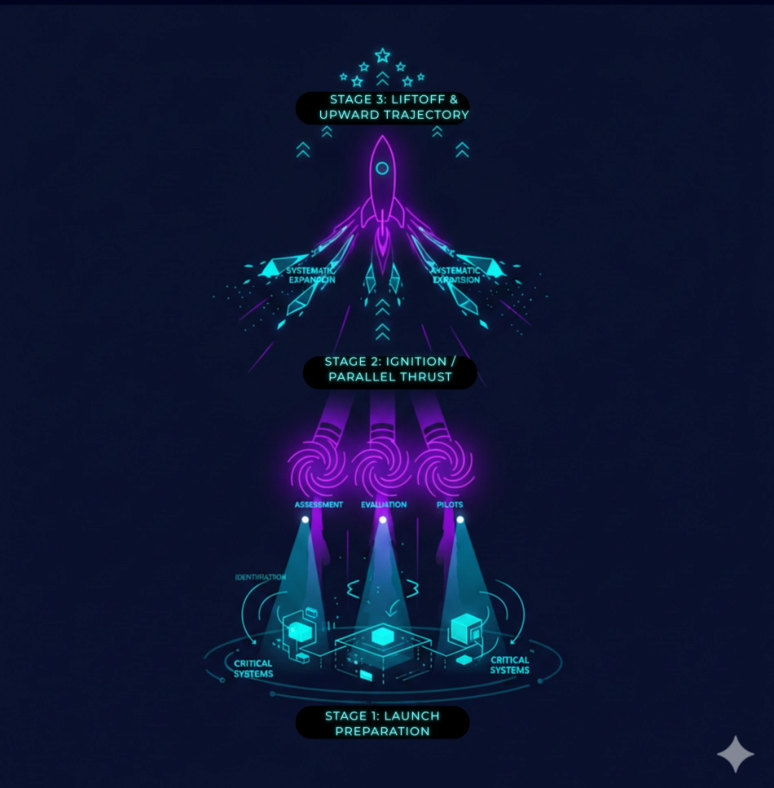
Expand systematically. Once pilots succeed on critical systems, expand to additional applications and data stores methodically. Each expansion cycle provides experience and refines processes, making enterprise-scale rollout more efficient than attempting comprehensive planning upfront.
The timeline is now
Organizations starting crypto-agility initiatives today can spread migration costs across multiple years. Organizations waiting until 2028 or 2029 will face crisis-driven migrations compressed into short timelines, with 3–5x higher costs and greater security risks.
Gartner's 2030 timeline for cryptographically relevant quantum computers, combined with enterprise migration timelines of three to five years from planning to completion, means the window for planned adoption is closing rapidly.
The cryptographic landscape is changing
This is the fastest-moving period in cryptography since public-key encryption emerged in the 1970s. Organizations that recognize crypto-agility as a strategic capability — not a tactical project — will emerge stronger, more secure and better prepared for future cryptographic transitions.
Is your organization ready? The answer may determine whether you navigate the quantum transition smoothly or face it in crisis mode.
Explore what ANKASecure© can do
See how enterprise cryptography becomes governed infrastructure instead of embedded code, or talk to our team about your specific requirements.
Contact usReferences
Gartner, Inc. "Gartner Identifies the Top Cybersecurity Trends for 2026." Press release, February 5, 2026. Read the press release
European Union Agency for Cybersecurity. "NIS2 Directive enters into force," 2024. Read the announcement
Gartner is a registered trademark and service mark of Gartner, Inc. and/or its affiliates in the U.S. and internationally and is used herein with permission. All rights reserved. The analysis and opinions expressed in this article are those of ANKATech Solutions Inc. and do not necessarily reflect the views of Gartner, Inc. Gartner does not endorse any vendor, product or service depicted in its research publications, and does not advise technology users to select only those vendors with the highest ratings or other designation. Gartner research publications consist of the opinions of Gartner's research organization and should not be construed as statements of fact.