Executive Summary
Enterprise cryptography is entering a period of unprecedented transformation.
For decades, cryptographic algorithms have been embedded directly within application code, tightly coupling security mechanisms with software implementation. This model has historically been manageable because cryptographic standards evolved slowly and changes were infrequent.
The emergence of post-quantum cryptography fundamentally alters this dynamic.
Organizations must now prepare for a large-scale transition from classical cryptographic algorithms to quantum-resistant mechanisms while maintaining operational continuity, regulatory compliance, and long-term data protection. At the same time, enterprises must support hybrid cryptographic models, manage heterogeneous algorithm environments, and protect data with extended confidentiality horizons.
These requirements expose a structural limitation in how cryptography is currently implemented.
When cryptographic logic is embedded in application code, every algorithm transition becomes a distributed engineering effort. Systems must be modified, redeployed, and retested across the enterprise. What should be a controlled infrastructure update instead becomes a large-scale application migration project.
This architectural model does not scale to the pace and complexity of modern cryptographic evolution.
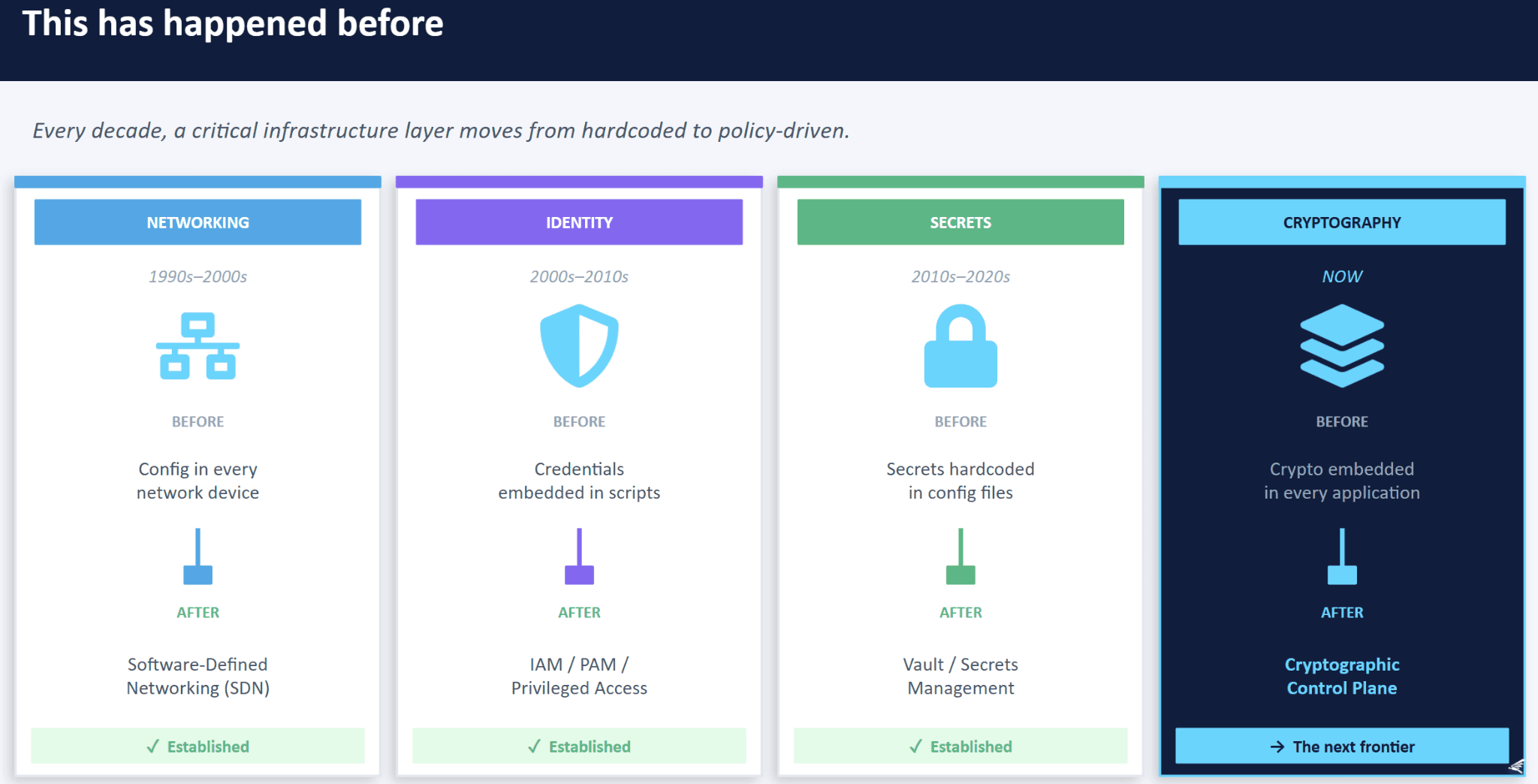
Other critical infrastructure capabilities have already undergone similar transformations. Networking evolved from device-level configuration to software-defined networking. Identity management transitioned from embedded credentials to centralized identity and access management platforms. Secrets management moved from configuration files to dedicated vault systems.
In each case, operational complexity forced the abstraction of critical capabilities into centralized control layers governed by policy.
Cryptography is now reaching the same inflection point.
Instead of embedding algorithms directly in software, applications express cryptographic intent while a centralized orchestration layer governs how cryptographic operations are executed.
This architecture enables organizations to:
- Decouple cryptographic decisions from application code and application release cycles
- Evolve cryptographic algorithms, mechanisms, and security strategies through governed infrastructure and policy
- Retain control over cryptographic trust, choice, and authority across distributed trust domains, including cloud, on-premises, hybrid, and third-party environments, without requiring centralized key custody
- Modernize the cryptographic protection of existing data without requiring originating applications to recreate or reprocess it
- Translate regulatory, jurisdictional, and organizational requirements into centrally governed, context-aware cryptographic policies
- Integrate cryptographic governance with heterogeneous enterprise identity, trust, key management, security, observability, and operational ecosystems
- Support classical, hybrid, and post-quantum cryptography as part of a continuously evolving cryptographic posture
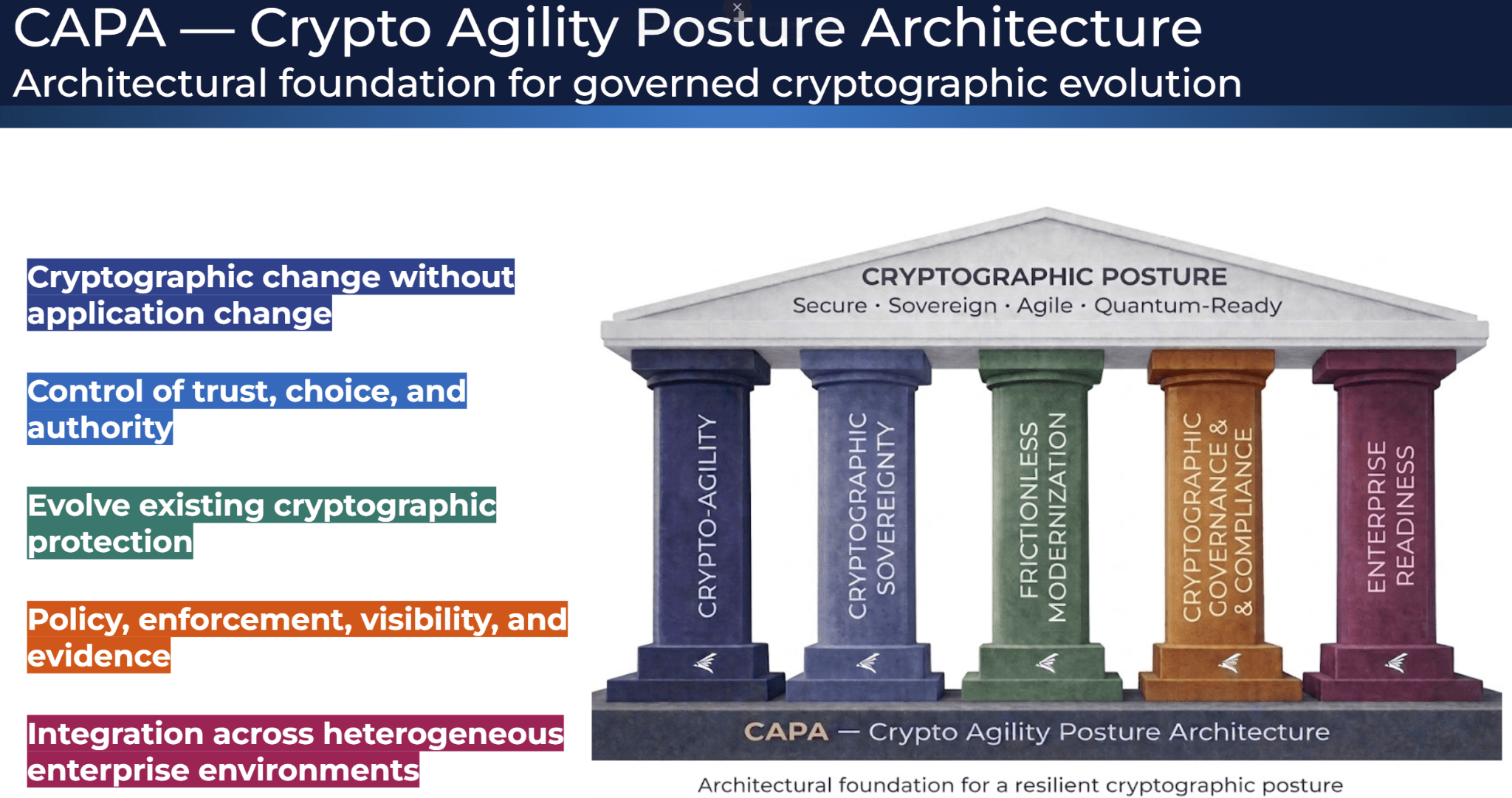
To operationalize this model, the paper introduces CAPA - Crypto Agility Posture Architecture, a framework that defines the foundational capabilities required to establish and sustain a modern cryptographic posture. CAPA organizes these capabilities around five pillars: Crypto-Agility, Cryptographic Sovereignty, Frictionless Modernization, Cryptographic Governance & Compliance, and Enterprise Readiness.
Together, the Cryptographic Control Plane and CAPA provide a path for enterprises to transition from static, application-bound cryptographic implementations toward governed cryptographic infrastructure capable of adapting to changing technologies, threats, regulations, jurisdictions, business relationships, and enterprise environments.
The post-quantum transition represents the first large-scale test of this architectural shift. It will not be the last.
Chapter 2The Post-Quantum Inflection Point
For most of the modern computing era, cryptographic evolution has been gradual.
Algorithms such as RSA, Diffie–Hellman, and elliptic-curve cryptography have provided the foundation for digital security for more than three decades. While improvements and parameter adjustments have occurred over time, the fundamental structure of public-key cryptography has remained largely stable.
Organizations could deploy cryptographic systems with the expectation that they would remain viable for many years.
The emergence of quantum computing changes this assumption.
Quantum algorithms such as Shor's algorithm demonstrate that sufficiently powerful quantum computers will be capable of efficiently breaking widely used public-key cryptographic schemes, including RSA and elliptic-curve cryptography. Although large-scale quantum computers capable of performing these attacks are not yet available, the cryptographic community broadly recognizes that such systems are a matter of technological progression rather than theoretical speculation.
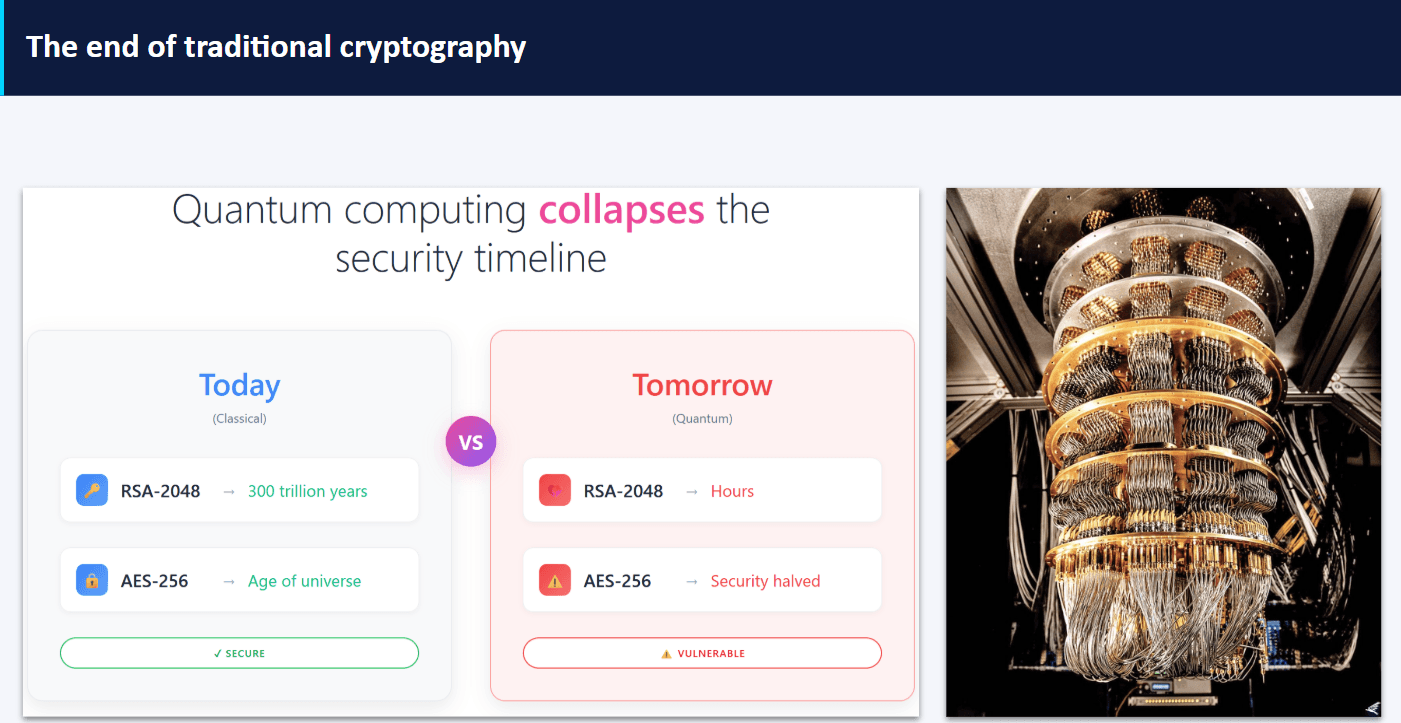
As a result, governments, standards bodies, and industry organizations are preparing for a transition toward post-quantum cryptography (PQC).
2.1 The emergence of post-quantum standards
In response to the anticipated impact of quantum computing on cryptography, global standardization efforts have accelerated significantly.
The U.S. National Institute of Standards and Technology (NIST) has led a multi-year process to evaluate and standardize quantum-resistant cryptographic algorithms. This process has resulted in the selection and standardization of several post-quantum algorithms designed to replace or complement existing public-key systems.
These include:
- ML-KEM (formerly CRYSTALS-Kyber) — for key establishment
- ML-DSA (formerly CRYSTALS-Dilithium) — for digital signatures
- FN-DSA (Falcon) — for compact digital signatures, under standardization as FIPS 206
- SLH-DSA — as a stateless hash-based signature scheme
These algorithms represent the foundation of the emerging post-quantum cryptographic ecosystem. However, their introduction does not simply require replacing one algorithm with another. The transition will require enterprises to support hybrid cryptographic models in which classical and post-quantum algorithms coexist during a prolonged migration period.
This coexistence significantly increases operational complexity.
2.2 The Harvest Now, Decrypt Later threat
The urgency of the post-quantum transition is not driven solely by the future capabilities of quantum computers. A significant threat already exists today.
This risk is particularly relevant for data with long confidentiality requirements, including:
- Financial records
- Intellectual property
- Government communications
- Healthcare information
- Long-term archival data
In these cases, the confidentiality lifetime of the data may exceed the time required for quantum capabilities to mature. For such data, the cryptographic transition must begin before quantum computers capable of breaking classical cryptography exist.
2.3 Regulatory acceleration
The transition toward post-quantum cryptography is not only driven by technological considerations. Regulatory and policy frameworks are increasingly mandating cryptographic modernization.
Governments and international institutions are introducing guidance and requirements that accelerate enterprise adoption of quantum-resistant cryptographic mechanisms. Examples include:
- U.S. federal directives requiring agencies to inventory and migrate vulnerable cryptographic systems
- European regulatory initiatives addressing long-term cryptographic resilience
- National cybersecurity strategies incorporating post-quantum preparedness
- Financial sector guidance on cryptographic agility and algorithm lifecycle management
These initiatives signal a broader shift in how cryptographic governance is expected to operate. Organizations will increasingly need not only to deploy strong cryptography, but also to demonstrate that cryptographic requirements can be translated into governed policy, enforced consistently across relevant systems, and adapted as standards, regulations, jurisdictions, and organizational requirements evolve.
2.4 The beginning of continuous cryptographic evolution
The post-quantum transition represents more than a single algorithm replacement. It signals the beginning of an era of continuous cryptographic evolution.
Historically, cryptographic transitions occurred infrequently. Organizations could update cryptographic systems every decade or more. In contrast, the emerging cryptographic landscape is characterized by:
- Multiple cryptographic algorithm families and security strategies
- Hybrid classical and post-quantum deployments
- Evolving regulatory and jurisdictional requirements
- Increasing algorithm and key lifecycle management demands
- Changing organizational, ecosystem, and interoperability requirements
- Long-term cryptographic resilience planning
This environment requires a fundamentally different approach to enterprise cryptography. The problem organizations now face is not simply selecting the correct algorithm. The challenge is building systems capable of adapting their cryptographic posture as algorithms, threats, standards, regulations, jurisdictions, trust requirements, and enterprise environments evolve.
This requirement exposes a structural weakness in the way cryptography is currently implemented within enterprise systems. The next section examines this structural limitation.
Chapter 3The Structural Problem: Hardcoded Cryptography
Despite the growing importance of cryptographic resilience, the way cryptography is implemented in most enterprise systems has remained largely unchanged for decades.
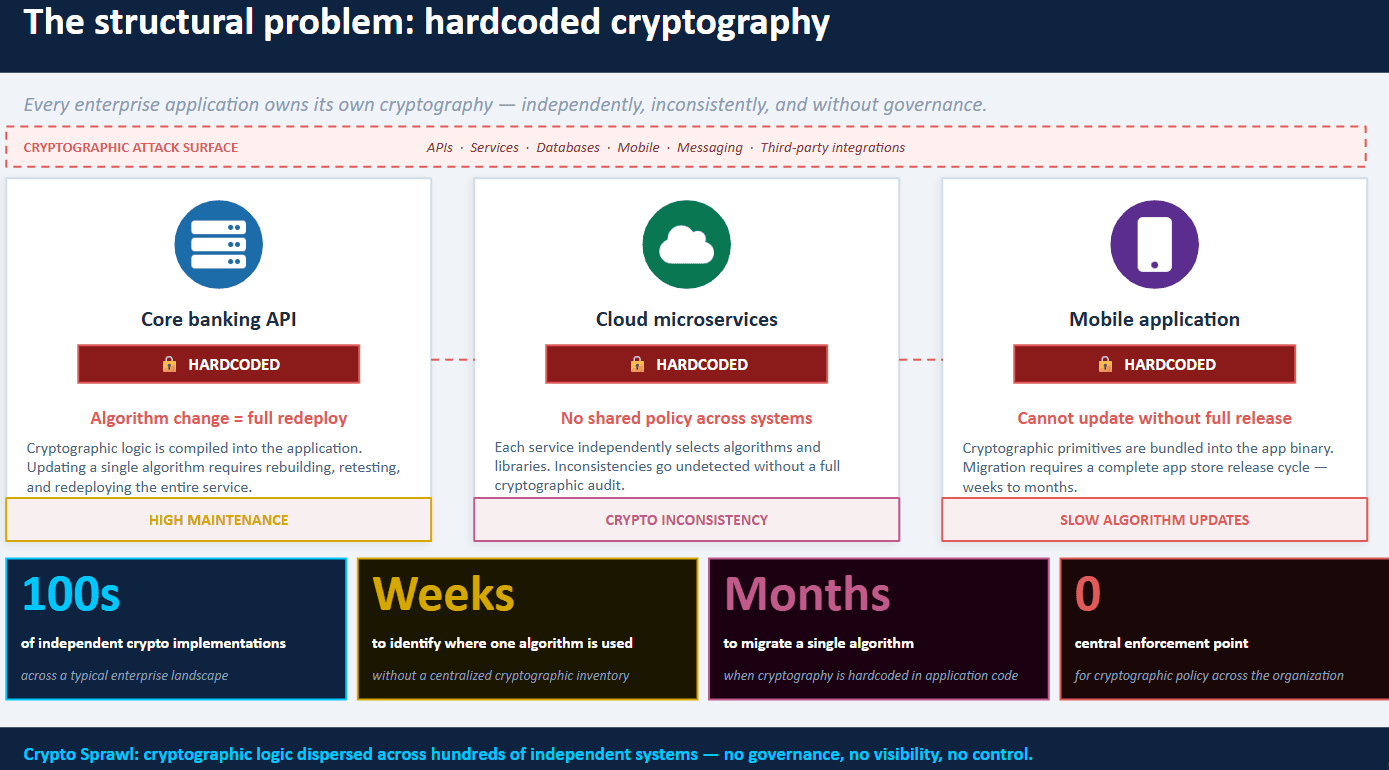
In the majority of applications, cryptographic logic is embedded directly within application code. Developers select specific algorithms, cryptographic libraries, and key-handling mechanisms during implementation, and these choices become tightly coupled with the software itself.
This design model creates a condition that can be described as hardcoded cryptography.
In this model, cryptographic decisions are made at development time and become part of the application's internal implementation rather than an externalized, governable infrastructure capability. This couples applications not only to specific algorithms and libraries, but also to decisions about key usage, trust infrastructure, cryptographic policy, interoperability, and lifecycle management. While this approach has historically been practical, it introduces significant limitations in modern enterprise environments where cryptographic requirements must evolve independently from the applications they protect.
3.1 Cryptography embedded across the application landscape
In most organizations, cryptographic functionality is implemented across a wide range of systems and technologies, including:
- Application services and microservices
- Backend systems and APIs
- Mobile and web applications
- Database encryption layers
- Messaging platforms
- Integration middleware
- Third-party libraries and frameworks
Each of these systems may implement cryptographic functions independently, often using different libraries, algorithm configurations, and key management approaches. As a result, cryptography becomes widely distributed across the software landscape, frequently without centralized visibility or governance.
In environments with hundreds or thousands of applications, identifying where specific algorithms are used can become extremely difficult. More importantly, the organization may lack a unified view of which cryptographic policies, trust dependencies, key-management mechanisms, and external cryptographic requirements apply across those systems. Crypto sprawl therefore creates not only a visibility problem, but also a governance and lifecycle-management problem.
3.2 The operational consequences of embedded cryptography
When cryptographic logic is embedded directly within application code, any change to the cryptographic environment requires modifications to the affected systems. This includes changes such as:
- Replacing vulnerable or deprecated algorithms
- Upgrading cryptographic libraries and mechanisms
- Introducing hybrid or post-quantum cryptography
- Modifying key handling or trust infrastructure
- Enforcing updated cryptographic policies
- Adapting to new regulatory, jurisdictional, or organizational requirements
- Supporting changing interoperability requirements with external systems
In such environments, a cryptographic transition is no longer a controlled infrastructure update. Instead, it becomes a distributed engineering effort across potentially hundreds of applications. Each affected system must typically be modified, recompiled or rebuilt, redeployed, retested, and revalidated for compliance.
This process can take months or even years in large organizations. As a result, organizations often postpone cryptographic upgrades until vulnerabilities become critical, creating extended periods of exposure.
3.3 The limitations of traditional key management
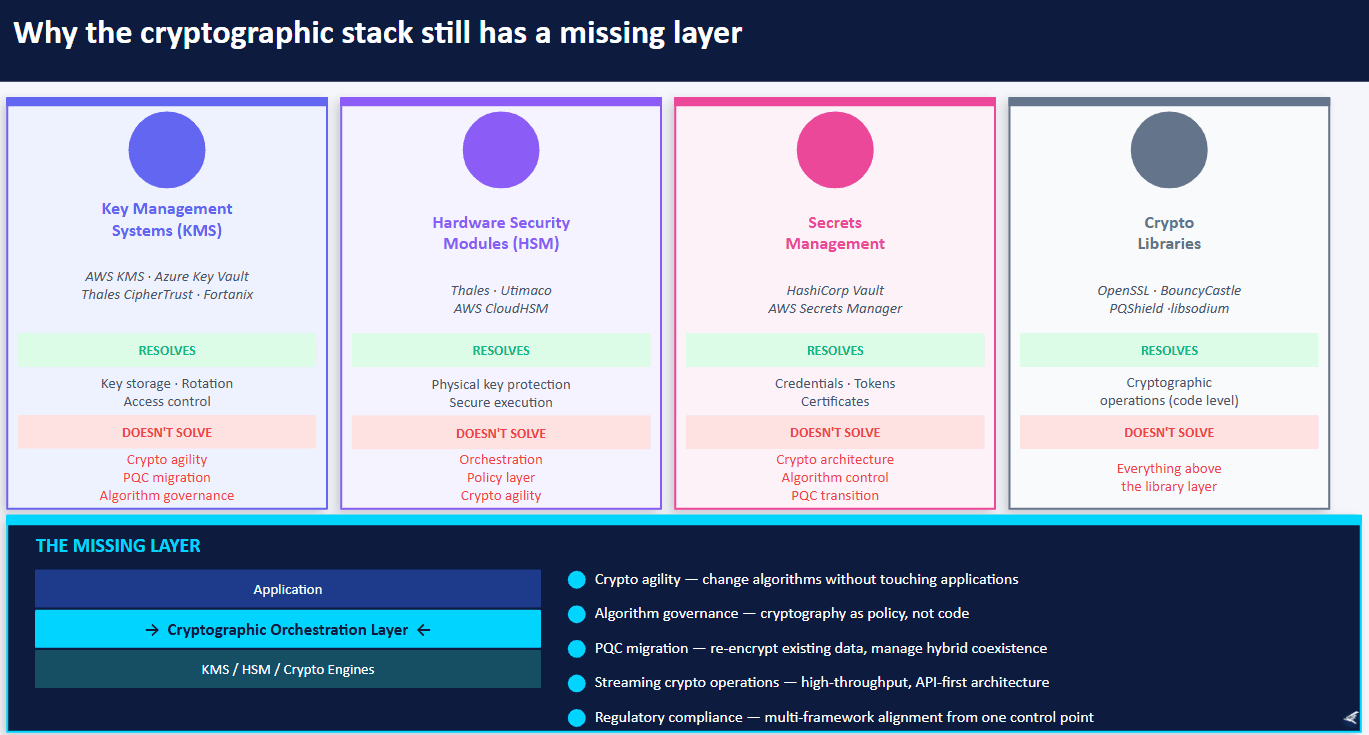
Key management systems (KMS) and hardware security modules (HSM) provide important capabilities for protecting cryptographic keys. However, they do not address the broader architectural problem created by embedded cryptographic logic.
While these systems secure key material, they generally do not control algorithm selection, cryptographic policy enforcement, algorithm lifecycle transitions, orchestration of cryptographic migrations, or hybrid cryptographic operations.
As a result, even organizations with strong key protection infrastructure may still face significant challenges when attempting to evolve their cryptographic environments. The limitation is not a failure of KMS or HSM technologies, which remain foundational components of enterprise cryptographic infrastructure. Rather, the architectural gap lies above them: organizations often lack a governance and orchestration layer capable of coordinating how cryptographic algorithms, keys, policies, trust infrastructure, and lifecycle transitions are applied across applications and environments.
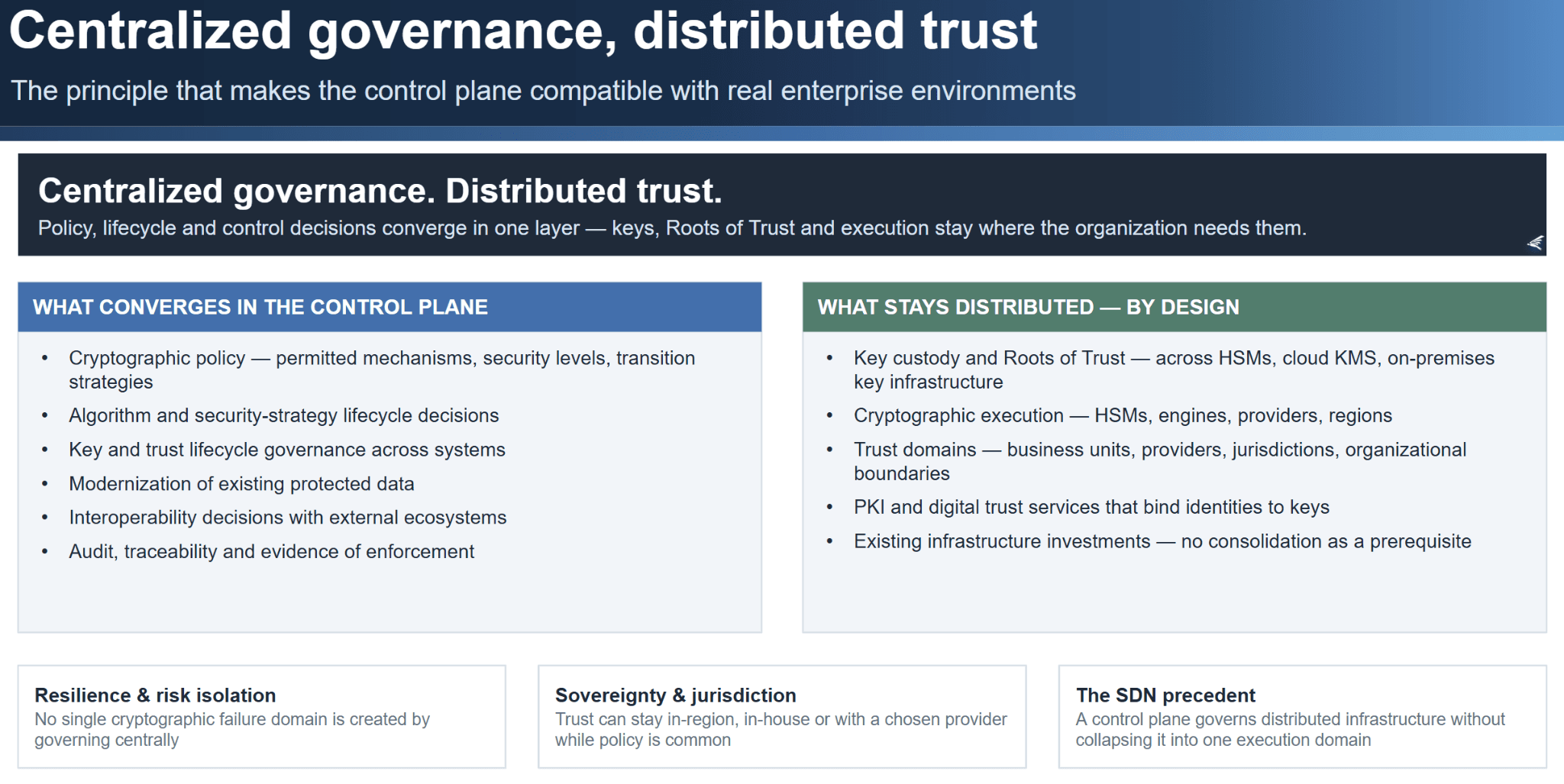
This architectural gap becomes more significant as key infrastructure becomes both heterogeneous and deliberately distributed. Enterprises may rely simultaneously on multiple HSMs, cloud KMS platforms, on-premises key infrastructure, and cryptographic services distributed across business units, providers, regions, jurisdictions, or independent trust domains. This distribution may be intentional, providing risk isolation, resilience, jurisdictional separation, or organizational autonomy. Centralized cryptographic governance should therefore not require centralized key custody. A Cryptographic Control Plane must be capable of coordinating policy and lifecycle governance across distributed trust infrastructures without forcing all key material into a single provider, repository, or cryptographic failure domain.
3.4 The mismatch between software architecture and cryptographic evolution
The architectural model of embedding cryptography within applications was developed in an era when cryptographic algorithms changed slowly. Today, that assumption is no longer valid.
The emergence of post-quantum cryptography, hybrid cryptographic models, and evolving regulatory requirements introduces a need for continuous cryptographic evolution. However, the current application-centric cryptographic model makes such evolution extremely difficult to manage at scale.
This creates a fundamental mismatch between the pace at which cryptographic environments must evolve and the ability of software systems to adapt to those changes.
Cryptographic coupling can also exist at the representation layer. Applications may become dependent not only on a specific algorithm or library, but also on the algorithm-specific formats, encodings, parameters, and metadata used to represent ciphertext, signatures, keys, or other cryptographic outputs. As cryptographic mechanisms diversify across classical, hybrid, and post-quantum models, these representation dependencies can become another source of application-level cryptographic debt.
Addressing this mismatch requires a shift in how cryptography is architected within enterprise systems. Rather than embedding cryptographic decisions within individual applications, organizations must begin to treat cryptography as a governable infrastructure capability, capable of coordinating cryptographic behavior across applications, policies, and heterogeneous, distributed trust infrastructures.
To understand how such transformations typically occur, it is useful to examine how other critical infrastructure domains have evolved in response to similar operational challenges.
Chapter 4The Historical Pattern of Infrastructure Abstraction
As digital systems grow in complexity, certain capabilities that were originally embedded within individual applications eventually evolve into shared infrastructure layers.
This transition typically occurs when operational complexity reaches a point where managing the capability within individual systems becomes inefficient, difficult to govern, or impossible to scale. At that point, the capability is abstracted into a shared control layer that provides centralized governance across multiple systems, while the underlying execution and infrastructure may remain distributed.
This pattern has appeared repeatedly in the evolution of enterprise computing.
4.1 Identity: from embedded credentials to identity infrastructure
In early enterprise systems, applications commonly stored and managed their own authentication mechanisms. User accounts, passwords, and authorization logic were frequently embedded directly within application code or local configuration files.
As organizations expanded their digital ecosystems, this model became increasingly difficult to manage. Users accumulated multiple credentials across systems, access policies became inconsistent, and enforcing security governance across applications proved challenging.
The solution was the emergence of identity and access management (IAM) platforms. IAM systems introduced centralized identity governance, allowing authentication and authorization decisions to be managed through shared infrastructure rather than embedded within each application.
4.2 Networking: from device configuration to software-defined networking
Networking infrastructure followed a similar trajectory. Historically, network behavior was configured directly on individual devices such as routers and switches. Each device maintained its own configuration and operational policies.
As networks scaled in size and complexity, this model became difficult to manage and prone to configuration inconsistencies. The introduction of software-defined networking (SDN) separated the control plane from the data plane, enabling centralized orchestration of network behavior across distributed infrastructure.
Network devices continued to forward traffic, but control decisions were governed by a centralized management layer. This separation enabled organizations to manage network behavior at scale.
Importantly, centralized control did not require centralized network execution: policy and orchestration became governable while the underlying infrastructure remained distributed.
4.3 Secrets: from configuration files to secure vaults
Secrets management provides another example of this pattern. In earlier software systems, credentials such as API keys, database passwords, and SSH keys were often stored directly within configuration files or application scripts. As security risks and operational complexity increased, this practice became untenable.
Modern systems now rely on dedicated secrets management platforms, where sensitive credentials are securely stored and accessed dynamically by applications when needed. Applications no longer manage secrets directly. Instead, they obtain them through dedicated secrets-management infrastructure designed specifically to govern credential lifecycle and access control.
4.4 A recurring architectural pattern
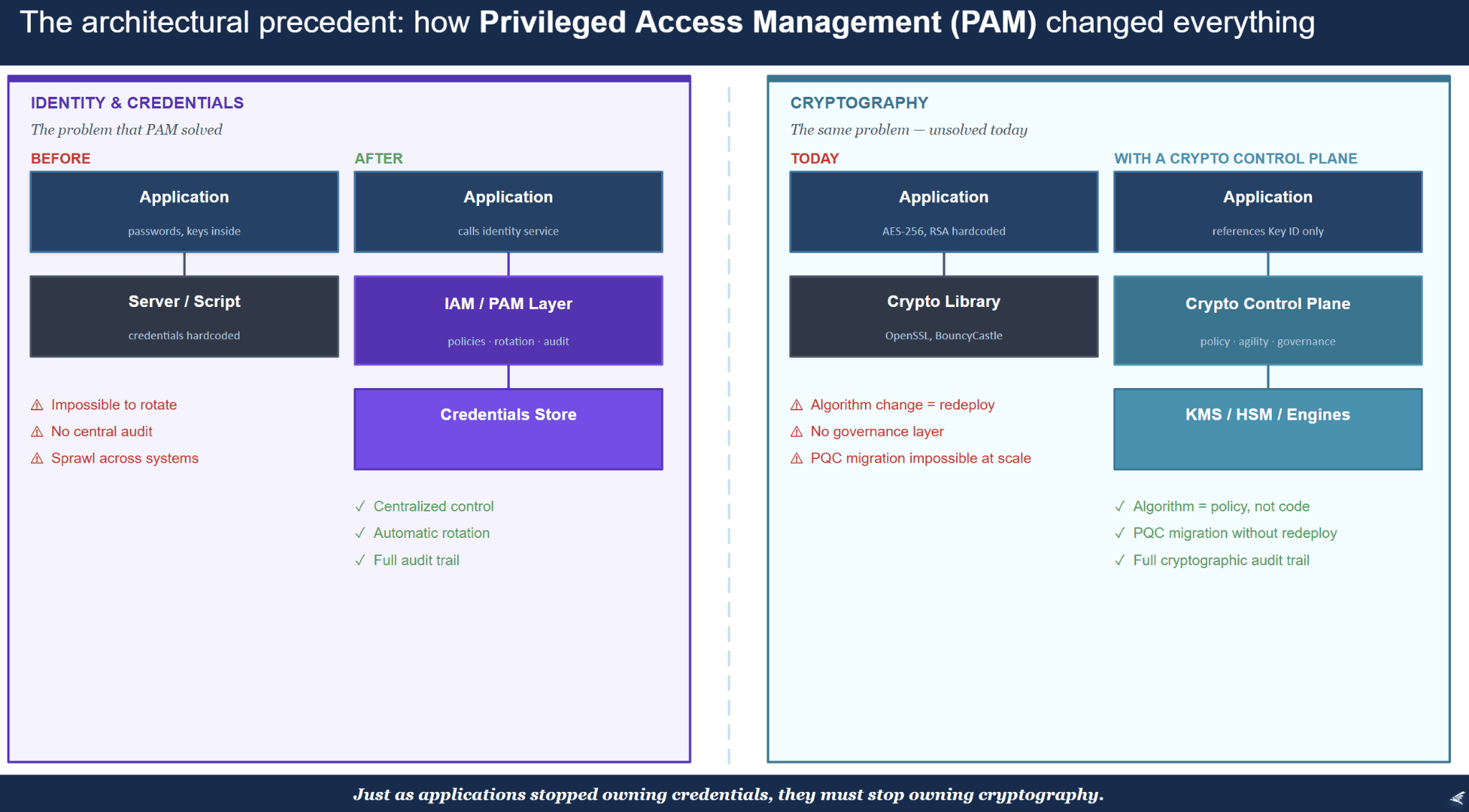
Across these examples, a common architectural transition can be observed: a capability that initially existed inside individual applications eventually becomes abstracted into a shared infrastructure layer governed by centralized policy and lifecycle management.
This pattern should not be interpreted as requiring the physical centralization of the underlying infrastructure. The architectural shift is the centralization of governance: policy, lifecycle, and control decisions become coordinated through a common layer, while execution, infrastructure, and trust domains may remain distributed. Software-defined networking provides a clear precedent: the control plane governs distributed infrastructure without requiring the infrastructure itself to collapse into a single execution domain.
This transition occurs when three conditions emerge:
- The capability becomes widely distributed across systems
- Operational complexity grows beyond what application-level management can sustain
- Governance and lifecycle control become critical requirements
Privileged Access Management provides a useful illustration of this transition: capabilities once owned independently by applications can evolve into shared infrastructure governed through a dedicated control layer.
The Emergence of the Cryptographic Control Plane
The historical evolution of enterprise infrastructure reveals a recurring architectural pattern: when a critical capability becomes widely distributed across systems and increasingly difficult to govern, it eventually evolves into a dedicated control layer.
Cryptography is now reaching that stage. The growing complexity of cryptographic environments, driven by post-quantum transitions, hybrid cryptographic models, evolving regulatory and jurisdictional requirements, heterogeneous and distributed trust infrastructure, external interoperability requirements, and long-term data protection needs, has exposed the limitations of embedding cryptographic logic directly within application code.
In this environment, cryptography can no longer remain an implementation detail within individual systems. It must evolve into governable infrastructure.
This shift gives rise to a new architectural layer: the Cryptographic Control Plane.
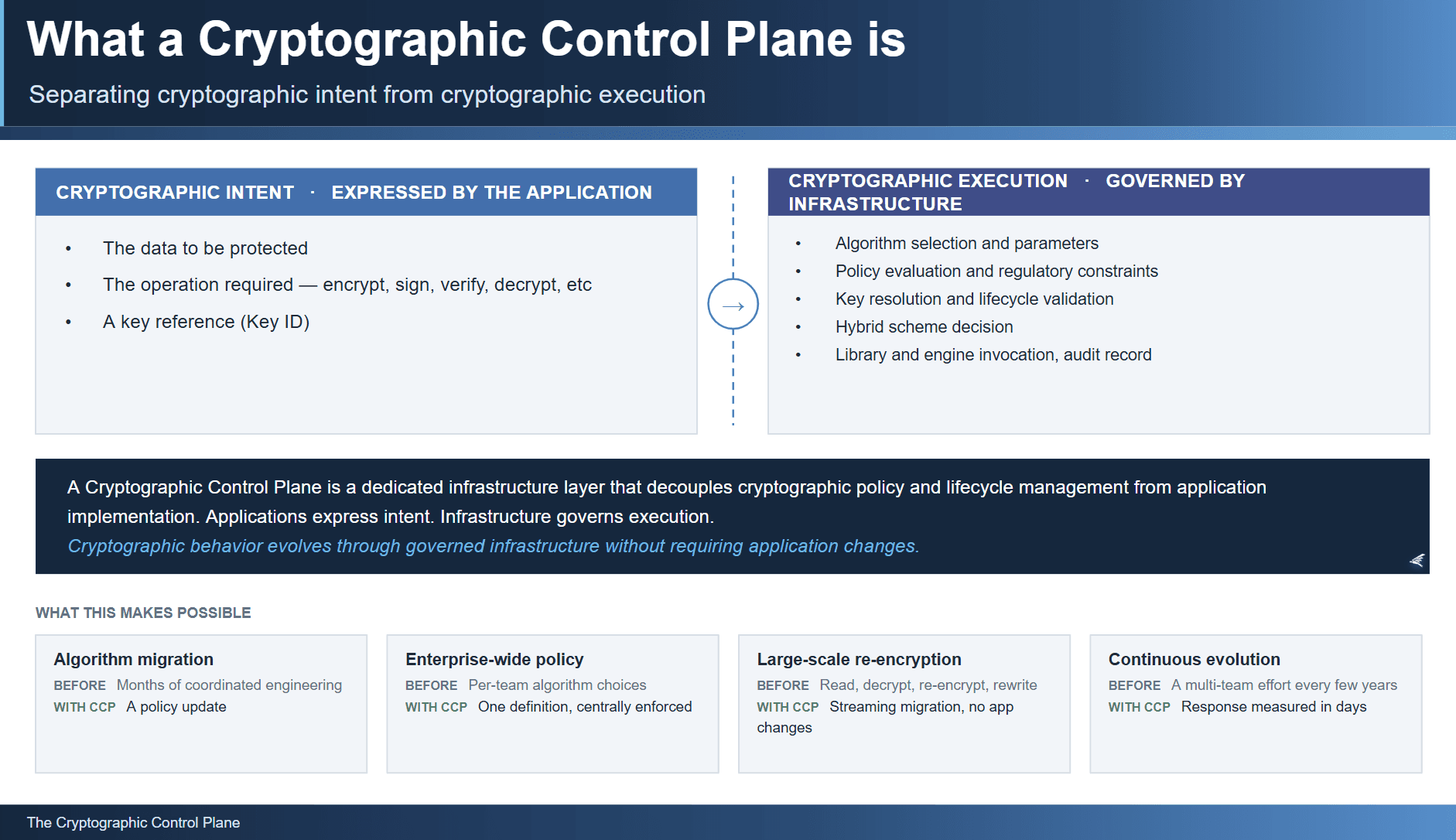
5.1 Separating cryptographic intent from cryptographic execution
In the traditional model of embedded cryptography, applications are responsible for selecting algorithms, invoking cryptographic libraries, managing key handling procedures, and implementing cryptographic workflows. This design tightly couples cryptographic implementation with application logic.
In contrast, a cryptographic control plane architecture separates two distinct concerns:
- Cryptographic intent — expressed by applications
- Cryptographic execution — governed by infrastructure
Applications specify the cryptographic operation they require, such as encrypting data, signing content, verifying signatures, or protecting application-level information. The Control Plane determines how that intent is fulfilled according to the applicable cryptographic policy and context, including which algorithms and security strategies are permitted, which keys and trust infrastructure participate, which cryptographic policies must be enforced, how hybrid cryptographic models are orchestrated, how external interoperability requirements are satisfied, and how cryptographic mechanisms evolve over time.
A Cryptographic Control Plane is not limited to policy evaluation or orchestration. It may provide cryptographic execution and key-management capabilities directly, while also coordinating external cryptographic infrastructure. Depending on the architecture and operation, cryptographic execution may occur within the Control Plane itself, within an HSM or KMS, or through another specialized cryptographic engine. Similarly, key material may be generated, managed, and used by the Control Plane while its protection remains anchored to an external Root of Trust controlled by the organization.
Cryptographic abstraction also extends to representation. Governed applications should not need to understand the algorithm-specific encoding, parameter structure, or output format of every cryptographic mechanism they consume. A Control Plane can provide stable representation models across heterogeneous cryptographic mechanisms while supporting specialized formats or profiles where interoperability requires them.
Representation abstraction does not imply universal interoperability. An external system can process a cryptographic representation only when it supports the algorithms, identifiers, parameters, profiles, and extensions used by that operation. The Control Plane therefore separates internal representation stability from external interoperability requirements.
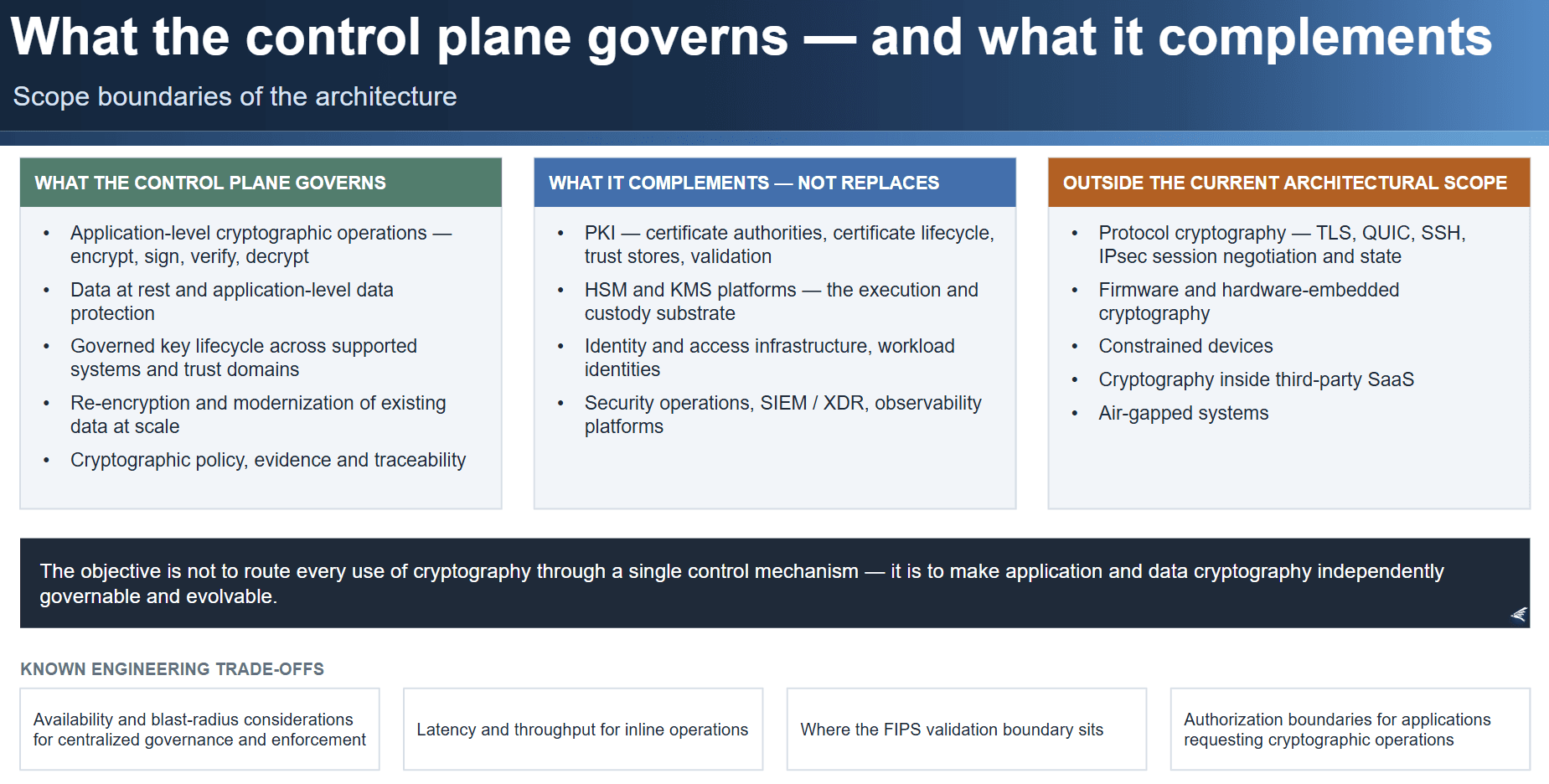
The Cryptographic Control Plane described in this paper is primarily concerned with application and data cryptography: cryptographic capabilities whose implementation, policy, and lifecycle would otherwise be embedded within or tightly coupled to individual applications. It is not intended to replace protocol-specific cryptography such as the session negotiation, ephemeral key establishment, and cryptographic state managed internally by protocols such as TLS, QUIC, SSH, or IPsec. Those mechanisms evolve through their respective protocols, standards, and implementations.
Similarly, the Control Plane complements rather than replaces PKI and other digital trust infrastructure. Certificate authorities, certificate lifecycle services, trust stores, and related trust mechanisms may continue to establish and maintain identity and trust relationships, while the Control Plane integrates with those capabilities where application and data cryptography depend on them. The objective is not to route every use of cryptography through a single control mechanism, but to make application and data cryptography independently governable and evolvable.
This separation allows cryptographic behavior to evolve without requiring direct modification of application code.
5.2 Governing cryptographic lifecycle at infrastructure scale
The introduction of a cryptographic control plane allows organizations to manage cryptographic lifecycle events at an infrastructure level rather than through distributed application changes. This includes operations such as:
- Introducing, deprecating, or replacing cryptographic algorithms and mechanisms
- Migrating between classical, hybrid, and post-quantum cryptographic strategies
- Managing cryptographic key and trust lifecycle transitions
- Enforcing context-aware cryptographic policies across systems and environments
- Coordinating cryptographic behavior across heterogeneous and distributed trust infrastructure
- Adapting cryptographic requirements across jurisdictions, organizational boundaries, and external ecosystems
- Governing cryptographic migrations without requiring originating applications to recreate protected data
Centralized governance does not require centralized cryptographic trust. A Cryptographic Control Plane may govern cryptographic behavior across keys and Roots of Trust distributed among multiple HSMs, KMS platforms, cloud providers, on-premises environments, regions, jurisdictions, or organizational domains. The objective is not to consolidate cryptographic assets into a single repository or provider, but to establish a common governance layer capable of coordinating policy and lifecycle decisions across them.
Centralized Governance, Distributed Trust.
Instead of requiring individual applications to implement these changes, cryptographic decisions can be governed centrally through infrastructure mechanisms while trust remains distributed and cryptographic execution occurs in the execution domain appropriate to the operation, policy, key architecture, and trust boundary. Applications remain largely unchanged while the underlying cryptographic environment evolves.
5.3 Enabling continuous cryptographic evolution
A key advantage of the control plane model is the ability to support continuous cryptographic evolution. The emerging cryptographic landscape is characterized by ongoing algorithm development, evolving threat models, regulatory and jurisdictional change, shifting trust requirements, changing business relationships, and increasingly heterogeneous enterprise technology environments.
Under the traditional application-centric model, each cryptographic transition requires coordinated engineering changes across multiple systems. Under a control plane architecture, these transitions can be governed through policy and infrastructure changes, reducing the operational burden associated with cryptographic change.
This capability becomes particularly important during prolonged migration periods, such as the transition toward post-quantum cryptography. Organizations must be able to support classical and post-quantum cryptographic mechanisms simultaneously while gradually evolving their environments.
5.4 From cryptographic implementation to cryptographic infrastructure
The emergence of a cryptographic control plane represents a shift in how cryptography is conceptualized within enterprise architecture.
Traditionally, cryptography has been treated primarily as a library-level capability implemented within applications. In the control plane model, cryptography becomes a governed infrastructure capability in which policy, orchestration, lifecycle management, and cryptographic execution are separated from individual application implementations.
Applications continue to perform their core business logic, while cryptographic intent is governed by a dedicated infrastructure layer responsible for policy enforcement, lifecycle management, crypto-agility, trust orchestration, and integration with the broader enterprise technology ecosystem.
5.5 The foundation for governed cryptographic infrastructure
The concept of the cryptographic control plane establishes the architectural foundation for governing cryptographic behavior across complex enterprise environments. However, implementing such a capability requires more than architectural abstraction.
Organizations must define the capabilities, governance mechanisms, trust principles, integration requirements, and operational practices required to support continuous cryptographic evolution across heterogeneous enterprise environments. To address this need, the CAPA framework — introduced in Chapter 7 of this paper — defines the foundational capabilities required to establish and sustain a governed cryptographic posture. The Control Plane defines where cryptographic governance occurs. CAPA defines the capabilities that governance must provide. Before examining that framework, Chapter 6 traces the five-stage evolution of enterprise cryptography that makes the control plane not only desirable but architecturally inevitable.
Chapter 6The five-stage evolution of enterprise cryptography
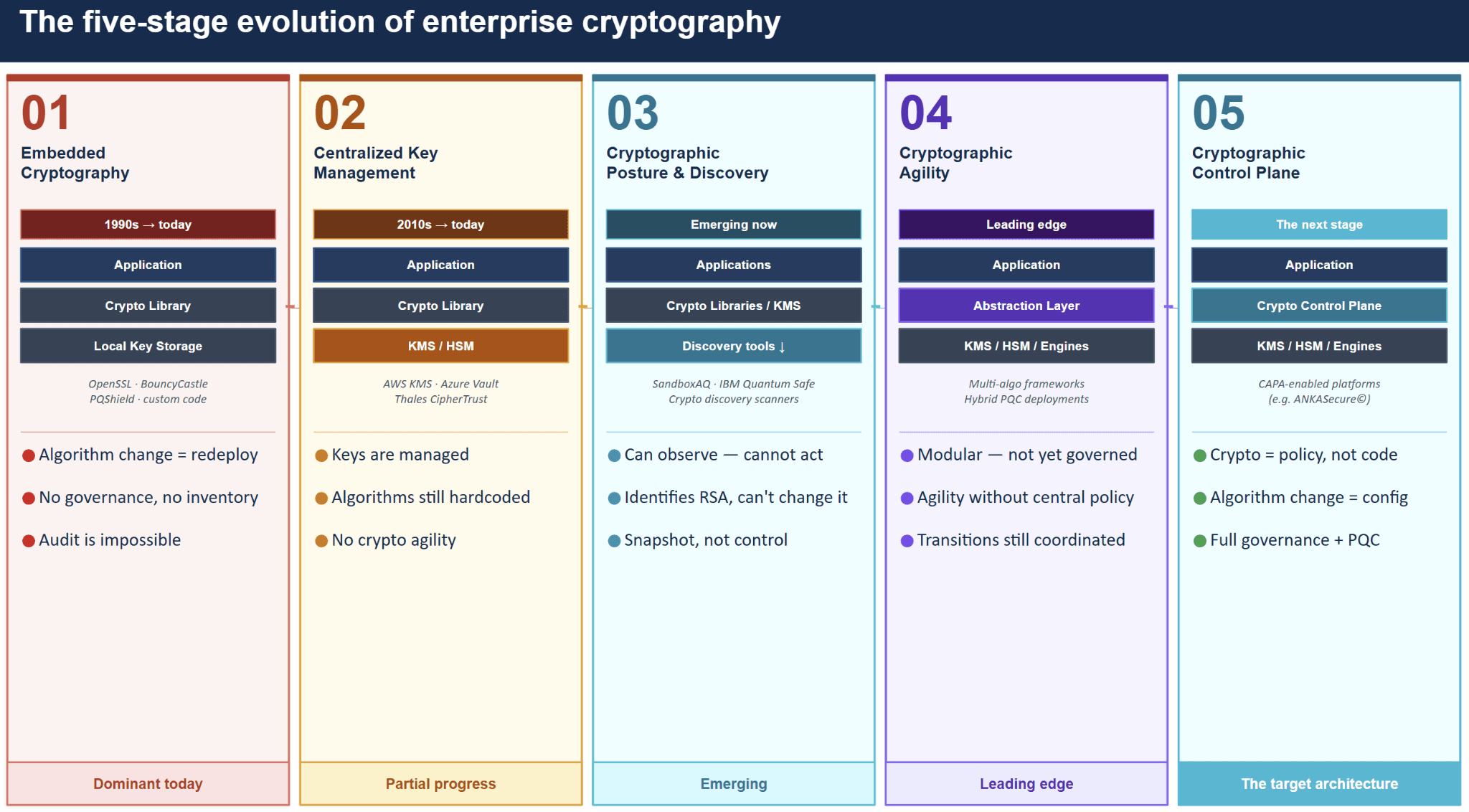
The emergence of the Cryptographic Control Plane does not represent a discontinuous leap. It is the product of a gradual, cumulative evolution in how enterprises have approached cryptographic management over several decades. Understanding this trajectory is essential for appreciating why the control plane model is not only desirable but architecturally inevitable.
Five distinct stages characterize this evolution. Each stage represents a meaningful advance over the previous one — yet each also introduces limitations that the next stage is designed to overcome. This progression reflects the broader pattern described in Chapter 4: as operational complexity grows beyond what application-level management can sustain, critical capabilities abstract into infrastructure.
6.1 Stage 1 — Embedded cryptography (1990s to present)
The first stage describes the model that remains dominant in most enterprise environments today. Cryptographic logic is implemented directly within each application, with developers selecting algorithms, libraries, and key-handling mechanisms at development time. Common examples include direct invocations of OpenSSL, BouncyCastle, or libsodium, and the use of local key storage mechanisms embedded within application configurations.
The defining characteristic of this stage is the tight coupling between cryptographic decisions and application code. Algorithm changes require redeployment. There is no centralized inventory of where cryptography is used. Audit is operationally impractical. The organization cannot act on its cryptographic environment without touching every affected application individually.
6.2 Stage 2 — Centralized key management (2010s to present)
The second stage introduced managed key infrastructure as a response to the growing operational complexity of protecting cryptographic keys across distributed systems. Organizations began adopting hardware security modules (HSMs), cloud key management services, and enterprise key management platforms to strengthen key protection, lifecycle management, access control, and auditability.
This stage represents meaningful progress: keys are better protected and increasingly subject to managed lifecycle controls. However, stronger key management does not resolve the fundamental problem of embedded cryptographic logic. Algorithms may remain hardcoded within applications, and key infrastructure does not by itself provide enterprise-wide governance over algorithm selection, cryptographic policy, interoperability, or cryptographic transitions. Furthermore, managed key infrastructure does not require all keys to reside in a single system or provider. Enterprises may deliberately operate multiple HSMs, KMS platforms, and independent trust domains for resilience, risk isolation, jurisdictional, organizational, or operational reasons. Cryptographic agility therefore remains limited even when key management is mature.
6.3 Stage 3 — Cryptographic posture and discovery (emerging now)
The third stage is characterized by the emergence of cryptographic posture and discovery capabilities. Organizations begin developing visibility into where cryptography is used, which algorithms and libraries are deployed, how keys and trust infrastructure are distributed, which systems depend on particular HSMs, KMS platforms, providers, or trust domains, and where exposure to vulnerable or deprecated mechanisms exists.
This is a critical advancement - but it is observation without control. An organization at this stage can identify that RSA-2048 is embedded in a given system, that a workload depends on a particular HSM or KMS, or that cryptographic trust is concentrated within a particular provider or domain. It cannot necessarily change those conditions through governance alone. Cryptographic discovery produces visibility into the current posture; it does not by itself produce control. The gap between visibility and action remains the defining limitation of this stage.
6.4 Stage 4 — Cryptographic agility (leading edge)
The fourth stage represents the leading edge of current enterprise cryptographic practice. Organizations at this stage have begun architecting systems with the expectation that algorithms will change, introducing abstraction layers between applications and cryptographic implementations, and enabling early adoption of hybrid classical and post-quantum mechanisms. Multi-algorithm frameworks and hybrid PQC deployments are characteristic of this stage.
Agility at this stage, however, remains partial. Cryptographic logic is more modular, but governance may still be fragmented across systems, platforms, or trust domains. Large-scale transitions, particularly those spanning multiple applications, key infrastructures, providers, or organizational environments, may still require significant coordination. Policy enforcement may exist within individual domains without providing a common governance model across the enterprise. The organization is moving in the right direction, but cryptographic agility has not yet become an enterprise-wide infrastructure capability.
6.5 Stage 5 — Cryptographic control plane (the next stage)
The fifth stage represents the convergence of visibility, agility, and governance into a unified infrastructure capability. Cryptographic behavior is no longer defined by application implementation decisions. It is governed by a dedicated infrastructure layer — the Cryptographic Control Plane — that orchestrates cryptographic operations, enforces policies, and manages algorithm lifecycle transitions across the enterprise environment. Importantly, this convergence occurs at the governance layer, not necessarily at the level of key custody or cryptographic execution. Keys, Roots of Trust, and cryptographic operations may remain distributed across multiple HSMs, KMS platforms, cloud providers, on-premises environments, regions, jurisdictions, and organizational domains. The Control Plane provides a common governance model across these trust domains without requiring them to be physically consolidated.
Centralized Governance, Distributed Trust.
Applications express cryptographic intent; infrastructure determines execution. Crypto is policy, not code. Algorithm changes become configuration events rather than engineering projects. Full governance and post-quantum readiness are operational capabilities, not future aspirations. This is the stage that CAPA-enabled platforms are designed to operationalize.
6.6 A pattern of inevitable abstraction
Each stage in this evolution is a rational response to the limitations of the previous one. Stage 2 emerged because embedded key management was operationally unsustainable. Stage 3 emerged because organizations had no visibility into their cryptographic exposure. Stage 4 emerged because static cryptographic architectures could not respond to accelerating algorithm change. Stage 5 emerges because partial agility without coordinated enterprise governance cannot scale to the complexity of continuous cryptographic evolution.
The endpoint of this evolution is therefore not the centralization of cryptography itself, but the abstraction and coordination of cryptographic governance across distributed systems and trust domains.
The question for enterprise architects is not whether this evolution will occur — the historical pattern is clear. The question is whether organizations will arrive at Stage 5 proactively, before the post-quantum transition creates the pressure, or reactively, under conditions of operational urgency and regulatory mandate. The framework that defines how organizations can build toward Stage 5 is introduced in the following chapter.
Chapter 7CAPA — Crypto Agility Posture Architecture
The concept of the Cryptographic Control Plane establishes a new architectural layer for governing cryptographic behavior across enterprise systems. However, implementing such a layer requires more than a conceptual shift. Organizations must define the operational capabilities required to manage cryptographic environments that evolve over time.
To address this need, this paper introduces CAPA — Crypto Agility Posture Architecture.
Rather than focusing on individual algorithms or cryptographic libraries, CAPA focuses on the organizational posture required to manage cryptography as infrastructure. The framework defines the capabilities that allow enterprises to adapt their cryptographic environments as technologies, threat models, standards, regulations, jurisdictions, trust requirements, business relationships, and enterprise technology environments evolve.
CAPA builds on the Cryptographic Control Plane architecture introduced in Chapter 5. At the foundation of that architecture is the separation of cryptographic intent from cryptographic execution: applications express the cryptographic capabilities they require, while infrastructure governs how those capabilities are fulfilled according to policy and context. This separation provides the architectural foundation upon which a governed cryptographic posture can be established.
7.1 From cryptographic implementation to cryptographic posture
Historically, cryptographic decisions have been made primarily at the implementation level. Developers selected algorithms, libraries, and cryptographic parameters during software development, embedding those decisions directly within application code. This model places the burden of cryptographic evolution on individual systems.
CAPA introduces a different perspective. Instead of treating cryptography as a static implementation choice, organizations manage cryptography as an evolving security posture governed by infrastructure capabilities, policies, and lifecycle management processes.
Under this model, cryptographic behavior is no longer determined solely by application code. It is governed by infrastructure that can adapt cryptographic mechanisms as conditions change. This shift enables organizations to transition from static cryptographic deployments to adaptive cryptographic environments.
A cryptographic posture therefore encompasses more than the algorithms an organization uses. It includes how cryptographic trust is established and distributed, how keys and cryptographic authority are governed, which policies apply under different contexts, how existing protected data can be modernized, and how cryptographic infrastructure integrates with the broader enterprise ecosystem.
A fundamental property of this posture is that governance and trust do not need to converge in the same place. Cryptographic policy, lifecycle, and control decisions can be coordinated through a common governance layer while keys, Roots of Trust, cryptographic execution, providers, and trust domains remain distributed according to organizational requirements.
7.2 The five pillars of CAPA
CAPA defines five foundational pillars required to establish a resilient and governable cryptographic posture. Together, these pillars provide the capabilities required to sustain cryptographic evolution across changing technologies, threats, policies, trust requirements, and enterprise environments. Each pillar is presented in the same structure: its definition and core principle, what the pillar means in practice, three scenarios contrasting a traditional architecture with the pillar in place, and a practical test.
DEFINITION
Crypto-agility is the ability to transition between cryptographic algorithms, mechanisms, and security strategies without requiring changes to application code, application releases, or disruption to business operations. It enables organizations to respond rapidly to algorithmic vulnerabilities, emerging standards, regulatory requirements, and evolving threat models without initiating application development, testing, certification, change-management, or deployment cycles. Crypto-agility supports transitions across classical, hybrid, and post-quantum cryptography while maintaining operational continuity. Rather than treating each cryptographic transition as a software engineering project, organizations establish the architectural capability to evolve cryptographic behavior through governed infrastructure and policy.
WHAT THE PILLAR MEANS
| Change without code Algorithms, mechanisms, security strategies, and supported cryptographic representations evolve without requiring repeated application changes or releases. | Respond rapidly Vulnerabilities, standards, regulatory requirements, and threat changes are absorbed through governed infrastructure. | |
|---|---|---|
| Classical → hybrid → PQC Cryptographic generations coexist and transition while business operations continue. | Capability, not project Cryptographic evolution becomes an architectural capability rather than a recurring engineering effort. |
CAPA IN PRACTICE
| 01 Responding to an algorithm vulnerability | ||
|---|---|---|
| SITUATION | TRADITIONAL ARCHITECTURE | WITH CRYPTO-AGILITY |
| A critical application depends on an algorithm that becomes vulnerable or unacceptable. | Code changes, regression testing, security validation, change approvals, and a new application release. | The cryptographic strategy changes through governed infrastructure and policy while the application continues operating without modification or redeployment. |
| 02 Transitioning to post-quantum cryptography | ||
|---|---|---|
| SITUATION | TRADITIONAL ARCHITECTURE | WITH CRYPTO-AGILITY |
| The organization must move from classical cryptography to hybrid classical-PQC and eventually to fully post-quantum mechanisms. | Each application becomes an independent migration project and introduces new algorithm dependencies. | The strategy evolves through the Control Plane, allowing governed applications to transition without embedding new algorithm dependencies. |
| 03 Evolving strategy without an application release | ||
|---|---|---|
| SITUATION | TRADITIONAL ARCHITECTURE | WITH CRYPTO-AGILITY |
| Security decides to change an algorithm family, security level, or cryptographic strategy even though no immediate vulnerability exists. | A new development, testing, approval, and release cycle is required only to change a cryptographic decision. | The change is implemented through cryptographic policy as an infrastructure governance activity. |
DEFINITION
Cryptographic sovereignty is the ability of an organization to retain ultimate authority and control over its cryptographic trust, cryptographic choices, and the use of cryptographic capabilities, regardless of where its data, infrastructure, or business processes operate. Organizations must be able to determine where and how cryptographic trust is established, how key material is protected and distributed across trust domains, which infrastructure or providers may participate, and under which jurisdictional and operational boundaries those trust domains operate. They must also retain the freedom to select the cryptographic algorithms, standards, and strategies appropriate to their security and trust requirements, without allowing external interoperability requirements to unnecessarily dictate their internal cryptographic posture. Cryptographic sovereignty does not require the centralization of key custody or trust infrastructure: organizations may deliberately distribute keys and Roots of Trust across multiple HSMs, KMS platforms, providers, environments, regions, or organizational domains. When protected information is shared with third parties, sovereignty extends beyond key ownership, governing who may exercise cryptographic operations, under what conditions, for how long, and when that authority can be revoked.
WHAT THE PILLAR MEANS
| Control where trust resides Keys and Roots of Trust remain across the HSMs, KMS platforms, providers, regions, and domains chosen by the organization. | Preserve cryptographic choice External interoperability requirements do not dictate the organization's entire internal cryptographic posture. | |
|---|---|---|
| Control cryptographic authority The organization governs who may exercise cryptographic operations, under what conditions, and for how long. | Distribute trust, keep governance Central governance does not require centralized custody or a single cryptographic failure domain. |
CAPA IN PRACTICE
| 01 Retaining control of the Root of Trust | ||
|---|---|---|
| SITUATION | TRADITIONAL ARCHITECTURE | WITH CRYPTOGRAPHIC SOVEREIGNTY |
| The organization deliberately operates multiple trust domains for resilience, jurisdiction, autonomy, or risk isolation. | Governing them coherently forces consolidation into a single provider, repository, or trust infrastructure. | Trust domains remain distributed while policy and governance are coordinated coherently. |
| 02 Maintaining revocable cryptographic authority over third parties | ||
|---|---|---|
| SITUATION | TRADITIONAL ARCHITECTURE | WITH CRYPTOGRAPHIC SOVEREIGNTY |
| Sensitive encrypted information must be processed by an external service provider. | A long-lived private key or persistent decryption capability is transferred to the third party. | Governed cryptographic authority is granted, constrained by identity, data scope, purpose, time, or policy, and revoked when required. |
| 03 Preserving cryptographic choice across trust domains | ||
|---|---|---|
| SITUATION | TRADITIONAL ARCHITECTURE | WITH CRYPTOGRAPHIC SOVEREIGNTY |
| A partner or external ecosystem requires a cryptographic standard different from the organization's preferred internal posture. | The external requirement becomes the de facto internal standard for everything. | The interoperability requirement is satisfied for that interaction while the internal cryptographic choice is preserved. |
DEFINITION
Frictionless modernization is the ability to evolve the cryptographic protection of existing data and systems without requiring the applications that originally produced that data to recreate, reprocess, or re-encrypt it. Organizations must be able to transform protected data as algorithms, keys, policies, trust infrastructure, and security requirements evolve, including data that may have been encrypted years earlier and is no longer available in its original application context. These transformations should be performed without creating persistent plaintext exposure and without requiring disruptive application changes or redevelopment. Frictionless modernization enables organizations to progressively re-encrypt, rotate, and migrate existing cryptographic assets, reducing long-lived dependencies on legacy keys and mechanisms while allowing cryptographic protection to evolve throughout the lifetime of the data.
WHAT THE PILLAR MEANS
| Modernize existing protection Historical encrypted data evolves even when the originating application has changed or disappeared. | No persistent plaintext exposure Transformations are performed without creating persistent plaintext intermediate artifacts. | |
|---|---|---|
| Break long-lived key dependencies Existing data is moved away from obsolete keys, key structures, or protection mechanisms. | Independent from applications Cryptographic protection evolves according to data lifetime rather than application lifecycle. |
CAPA IN PRACTICE
| 01 Modernizing historical encrypted data | ||
|---|---|---|
| SITUATION | TRADITIONAL ARCHITECTURE | WITH FRICTIONLESS MODERNIZATION |
| Millions of records or files were encrypted years ago using mechanisms that now need to change. | The original application or plaintext is required to recreate and re-encrypt the data, which is often impossible. | Existing protected data is transformed under new algorithms, keys, or policies without requiring the originating application to recreate it. |
| 02 Correcting long-lived key dependencies | ||
|---|---|---|
| SITUATION | TRADITIONAL ARCHITECTURE | WITH FRICTIONLESS MODERNIZATION |
| Large historical datasets remain protected under keys or key structures beyond current policy limits. | Changing the protection requires reconstructing application logic or manually tracking which key protects which data. | Protection is rotated, segmented, or migrated to new keys and hierarchies independently from the original applications. |
| 03 Migrating legacy cryptographic infrastructure | ||
|---|---|---|
| SITUATION | TRADITIONAL ARCHITECTURE | WITH FRICTIONLESS MODERNIZATION |
| A legacy key store, trust infrastructure, or cryptographic mechanism must be retired while years of protected data still depend on it. | Migration becomes a disruptive big-bang project with business systems stopped. | Cryptographic assets move progressively to the target infrastructure while business systems continue operating. |
DEFINITION
Cryptographic governance and compliance is the ability to translate internal security requirements, regulatory obligations, industry standards, and jurisdictional constraints into centrally governed and enforceable cryptographic policies across the enterprise. Organizations must be able to maintain multiple cryptographic policies simultaneously and apply them according to context, including the data being protected, the operation being performed, the systems involved, the parties exchanging information, and the jurisdictions or requirements that apply. These policies should govern permitted cryptographic mechanisms, security levels, key lifecycles, trust requirements, and transition strategies through infrastructure rather than application-specific implementations. Governance must also provide visibility, traceability, and evidence of policy enforcement. As regulations, standards, business relationships, jurisdictions, and organizational structures evolve, cryptographic policy must adapt without requiring changes to the applications it governs.
WHAT THE PILLAR MEANS
| Requirements become policy Security, regulatory, jurisdictional, and organizational requirements are translated into enforceable cryptographic policy. | Policy follows context Different policies apply according to data, operation, system, counterparty, purpose, or jurisdiction. | |
|---|---|---|
| Govern centrally, enforce consistently Cryptographic decisions are managed through infrastructure rather than duplicated across applications. | Produce evidence Visibility, traceability, and enforcement records make cryptographic compliance demonstrable. |
CAPA IN PRACTICE
| 01 Applying policy across multiple jurisdictions | ||
|---|---|---|
| SITUATION | TRADITIONAL ARCHITECTURE | WITH GOVERNANCE & COMPLIANCE |
| A multinational organization must satisfy different cryptographic requirements across locations and counterparties. | Requirements are implemented independently within applications and integrations, or exceptions are hand-coded per counterparty. | Multiple policies coexist and the appropriate one is applied according to data, operation, counterparty, purpose, and jurisdiction. |
| 02 Adapting governance after a merger or acquisition | ||
|---|---|---|
| SITUATION | TRADITIONAL ARCHITECTURE | WITH GOVERNANCE & COMPLIANCE |
| A merger changes applicable corporate policies, contractual requirements, jurisdictions, or trust obligations, with no algorithm change. | Affected applications must be individually reviewed and modified. | New requirements are introduced and enforced through centralized cryptographic policy across the affected systems. |
| 03 Enforcing a new enterprise security requirement | ||
|---|---|---|
| SITUATION | TRADITIONAL ARCHITECTURE | WITH GOVERNANCE & COMPLIANCE |
| A security team prohibits an algorithm, key lifecycle, security level, or cryptographic strategy for a class of data. | Every affected system must be identified, modified, validated, and audited independently. | The requirement becomes centrally governed policy with consistent enforcement, visibility, and evidence that it was applied. |
DEFINITION
Enterprise readiness is the ability of cryptographic infrastructure to operate as a native component of complex, heterogeneous enterprise technology environments rather than as an isolated security silo. A modern cryptographic architecture must integrate with the identity and access infrastructure, cryptographic and trust services, key management and hardware security infrastructure, security operations, observability platforms, communication services, and operational tooling that organizations already use. It must also interoperate with external systems and ecosystems that may impose different protocols, formats, standards, or cryptographic requirements. Enterprise readiness assumes that multiple technologies, providers, and deployment models may coexist across the organization and must therefore support extensibility as those environments evolve. The cryptographic infrastructure should adapt to the enterprise ecosystem, allowing organizations to preserve existing technology investments and operational practices while introducing governed cryptographic capabilities across them.
WHAT THE PILLAR MEANS
| Integrate with what exists Works with existing identity, trust, key, security, observability, communications, and operational systems. | Support heterogeneous environments Multiple providers, technologies, trust domains, and deployment models coexist. | |
|---|---|---|
| Preserve existing investments Governance improvement does not require immediate replacement or consolidation of enterprise infrastructure. | Interoperate externally External protocols, cryptographic formats, representation profiles, standards, and mechanism requirements can be supported without redefining the internal cryptographic architecture. |
CAPA IN PRACTICE
| 01 Integrating with the existing enterprise security ecosystem | ||
|---|---|---|
| SITUATION | TRADITIONAL ARCHITECTURE | WITH ENTERPRISE READINESS |
| The organization already operates IAM, workload identity, HSM/KMS, PKI, SIEM/XDR, observability, communications, and operational tooling. | A new cryptographic platform creates parallel identity, monitoring, trust, and operational silos. | The Control Plane integrates with existing enterprise capabilities and participates naturally in established operational processes. |
| 02 Operating across heterogeneous environments after an acquisition | ||
|---|---|---|
| SITUATION | TRADITIONAL ARCHITECTURE | WITH ENTERPRISE READINESS |
| Two organizations use different identity systems, HSM/KMS platforms, monitoring tools, trust services, and deployment models. | Common cryptographic governance depends on first consolidating the surrounding technology landscape. | Both environments participate under common governance while underlying technologies evolve independently. |
| 03 Interoperating with external cryptographic ecosystems | ||
|---|---|---|
| SITUATION | TRADITIONAL ARCHITECTURE | WITH ENTERPRISE READINESS |
| A customer, provider, government system, or industry network requires protocols, formats, standards, or mechanisms different from those used internally. | The enterprise adapts its internal architecture around each counterparty. | External interoperability is handled as an integration capability while the internal cryptographic posture remains intact. |
7.3 Establishing a cryptographic posture for continuous evolution
Together, the five pillars of CAPA define the capabilities required to establish and sustain a governed cryptographic posture at enterprise scale. Crypto-Agility enables cryptographic strategies to evolve without application change. Cryptographic Sovereignty preserves organizational control over trust, choice, and authority. Frictionless Modernization enables existing protected data and cryptographic infrastructure to evolve over time. Cryptographic Governance & Compliance translates requirements into enforceable policy and verifiable evidence. Enterprise Readiness allows these capabilities to operate across the heterogeneous technologies, trust domains, providers, and external ecosystems that characterize real enterprise environments.
These capabilities are complementary. Centralized governance does not require centralized trust. Cryptographic agility does not eliminate the need to modernize historical data. Sovereignty does not eliminate interoperability requirements. Enterprise readiness allows all of these capabilities to coexist across distributed and evolving environments. Together, the pillars allow organizations to move beyond static cryptographic implementations toward adaptive cryptographic infrastructure capable of continuous evolution.
This posture can extend across cryptographic domains without requiring every domain to use the same execution or control mechanism. Application and data cryptography, transport security, PKI, key infrastructure, and other trust services may retain specialized operational mechanisms while participating in a coordinated organizational cryptographic posture. CAPA therefore describes the capabilities required to govern cryptographic evolution, not a requirement to centralize every cryptographic function within a single platform.
However, organizations vary significantly in their ability to implement these capabilities. Understanding how enterprises progress toward a governed cryptographic posture requires a model that describes the stages of cryptographic maturity. That model is introduced in the following chapter.
Prefer the PDF? Download it with your corporate email.
The CAPA Cryptographic Maturity Model
Organizations differ significantly in how cryptography is implemented, governed, and evolved across their technology environments. Some systems still rely on cryptographic mechanisms embedded directly within application code, while others have begun to introduce centralized key management, policy governance, and cryptographic lifecycle management capabilities.
To help organizations understand their current position and define a path toward governed cryptographic infrastructure, this paper introduces the CAPA Cryptographic Maturity Model.
Maturity should therefore be understood as the organization's ability to exercise the capabilities defined by CAPA across an increasing portion of its cryptographic environment. Progress is not determined by the adoption of a particular technology, provider, or key infrastructure model, but by the organization's increasing ability to govern cryptographic change, retain cryptographic sovereignty, modernize existing protection, enforce policy and compliance requirements, and operate across heterogeneous enterprise environments.
The model describes the progressive evolution from embedded cryptographic implementations toward fully governed cryptographic infrastructure operated through a cryptographic control plane. It defines six levels that reflect increasing organizational capability in governing cryptographic change. Two principles underpin the model. First, maturity is measured by capability — by what the organization can do today in response to a vulnerability, a standard change, or an algorithm deprecation — not by how much legacy migration remains pending. A legacy estate in active migration does not reduce the maturity level; it represents work in progress, not a deficit of capability. Second, post-quantum cryptography is not a level to be reached at the end of the journey. It is a dimension that improves at every level, and that can begin to be adopted from the moment the organization deploys a Cryptographic Control Plane. Rather than representing discrete technical deployments, these levels provide a diagnostic framework that helps organizations understand where they stand and what capabilities they need to develop next.
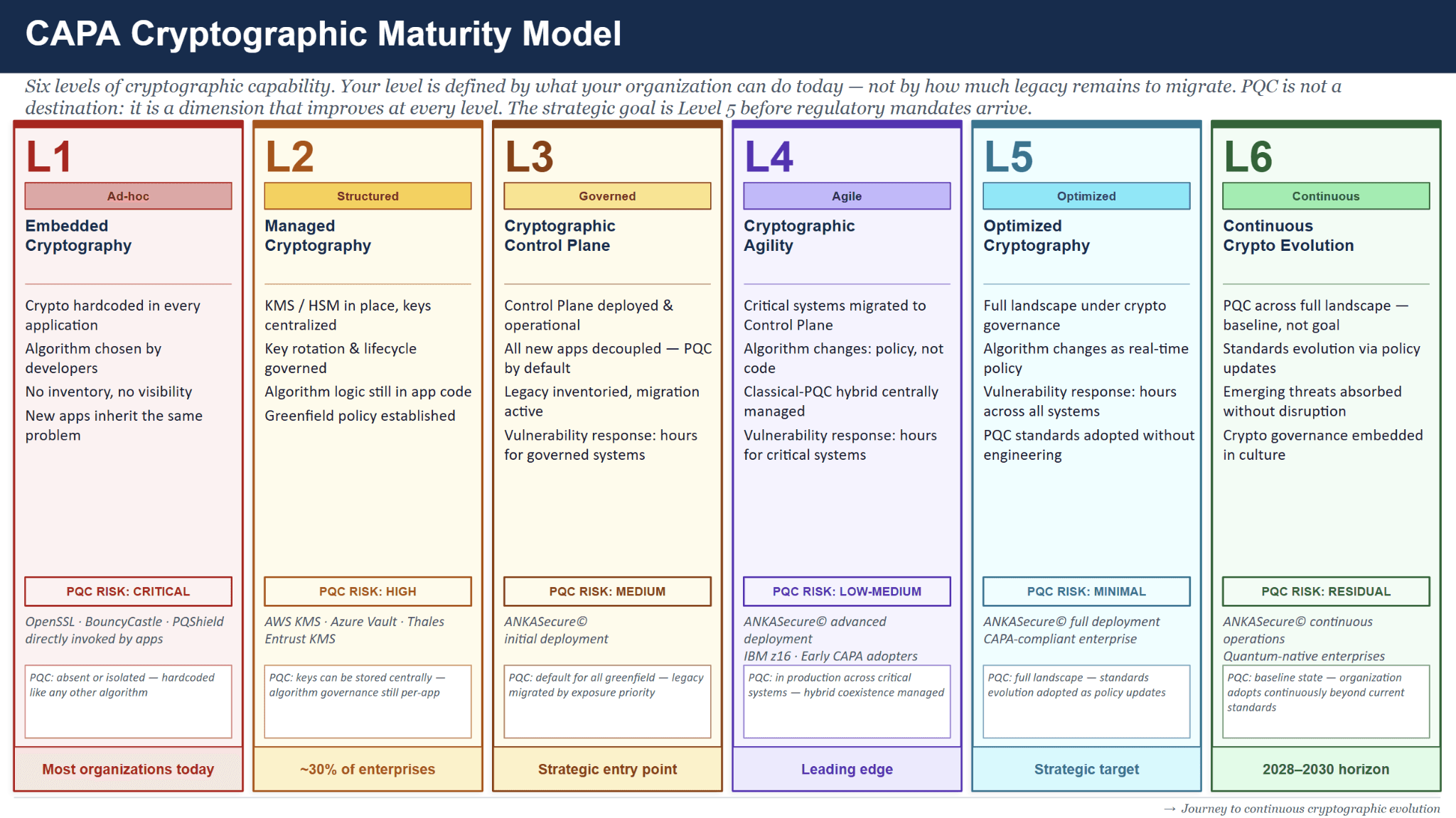
Level 1 — Embedded Cryptography
At the first level of maturity, cryptographic logic is embedded directly within application code. Developers select algorithms, libraries, and cryptographic parameters during implementation, and these decisions become tightly coupled with the application itself.
Common characteristics of this stage include:
- Algorithm selection embedded in code
- Cryptographic libraries directly invoked by applications
- Inconsistent implementations across systems
- Limited visibility into where cryptography is used
- Manual upgrades when vulnerabilities emerge
In this model, cryptographic transitions require coordinated engineering changes across multiple systems, making large-scale cryptographic upgrades slow and operationally complex. Many organizations today still operate largely at this level. A critical characteristic of Level 1 is that the problem perpetuates itself: new applications are built with the same embedded cryptographic patterns as legacy systems, because there is no architectural discipline or policy requiring otherwise. The cryptographic debt grows with every new deployment. Post-quantum cryptography at this level is absent or isolated — if a team adopts a PQC algorithm, it is hardcoded into that application just as any classical algorithm would be, solving nothing at the structural level.
Level 2 — Managed Cryptography
At the second level of maturity, organizations begin introducing centralized components that improve the management of cryptographic assets. This often includes technologies such as hardware security modules (HSMs), key management systems (KMS), certificate management platforms, and centralized key lifecycle management.
These technologies significantly improve the protection and governance of cryptographic keys. However, even when keys are professionally managed through HSMs, KMS platforms, certificate management systems, or other dedicated infrastructure, cryptographic logic often remains embedded within application code. These key and trust infrastructures may themselves be distributed across multiple providers, environments, or organizational domains. Their consolidation is not a prerequisite for cryptographic maturity. The limitation at this level is not where keys reside, but that cryptographic behavior and lifecycle decisions remain substantially coupled to individual applications. Algorithm selection and cryptographic workflows still depend largely on application implementations. As a result, cryptographic upgrades still require modifications across multiple systems. Level 2 is the earliest point at which organizations should establish a greenfield policy: a formal commitment that all new applications developed from this point forward will not embed cryptographic logic directly, but will instead consume cryptographic services through an abstraction layer. This policy does not resolve existing technical debt — but it stops its accumulation. Post-quantum cryptography at this level can be introduced into the key management layer — PQC keys can be stored and rotated in the HSM or KMS — but algorithm governance remains per-application, making enterprise-wide PQC adoption uncoordinated and ungoverned.
Level 3 — Cryptographic Control Plane
Level 3 represents the structural inflection point of the maturity model. At this level, the organization deploys a Cryptographic Control Plane — a dedicated infrastructure layer that decouples cryptographic behavior from application code and centralizes its governance. This is not an incremental improvement over Level 2; it is an architectural change that fundamentally alters the organization’s capacity to govern, adapt, and respond.
The capability that defines Level 3 is not the existence of a cryptographic inventory — it is the ability to act on cryptographic policy without modifying or redeploying applications. From the moment the Control Plane is operational, the organization can establish a greenfield policy under which new systems consume governed cryptographic services rather than embedding algorithm-specific cryptographic decisions directly in application code. They express cryptographic intent through standardized interfaces, and the Control Plane enforces the corresponding policy. Post-quantum and hybrid mechanisms can therefore be introduced where required by risk, policy, interoperability, or regulatory requirements without creating new application-level algorithm dependencies.
For the existing legacy landscape, the Control Plane initiates a parallel process: discovery and phased migration. The brownfield estate is inventoried, systems are prioritized by PQC exposure and data sensitivity, and migration proceeds in structured phases. Systems not yet migrated remain constrained by their embedded implementations — but they are no longer representative of the organization’s current capability. The organization can already respond to a vulnerability in any governed system in hours. The legacy backlog is work in progress, not a measure of maturity. Discovery is applied to the past. The Control Plane governs the future.
Level 4 — Cryptographic Agility
At the fourth level of maturity, the Cryptographic Control Plane has been operational for a significant period and its coverage has expanded substantially across the enterprise landscape. The focus has shifted from deployment to depth of migration: the Control Plane now governs the most critical and most exposed systems, and the brownfield migration is in advanced stages.
The critical and high-risk systems — those with the greatest PQC exposure or the highest data sensitivity — have been migrated to the Control Plane and now operate under centralized cryptographic governance. Algorithm transitions in these systems no longer require code changes; they are executed through governed policy changes without requiring application code changes or redeployment. Classical-PQC hybrid coexistence is managed centrally across the governed landscape. When a vulnerability is disclosed in an algorithm used by a critical system, the organization can respond in hours, not months.
The defining characteristic of Level 4 is the dual-track state of the cryptographic environment. The greenfield is fully governed: systems deployed under the new architectural model operate through centrally governed cryptographic policy, allowing classical, hybrid, or post-quantum strategies to be applied according to organizational requirements. The brownfield is in advanced migration: lower-risk and lower-priority systems are progressively being onboarded to the Control Plane as planned maintenance windows allow. The gap between these two tracks represents the remaining technical debt — and systematically closing it is the primary operational objective of Level 4. The organization’s overall vulnerability response time reflects this dual state: hours for governed systems, days or weeks for those still in the migration queue.
Level 5 — Optimized Cryptography
Level 5 represents enterprise-scale adoption of governed cryptographic infrastructure. At this stage, the organization's relevant cryptographic landscape operates predominantly under the Control Plane, including the critical brownfield environments identified for migration. Cryptographic policy and lifecycle decisions are governed coherently across the enterprise, while cryptographic execution, keys, and Roots of Trust may remain distributed across heterogeneous HSMs, KMS platforms, providers, jurisdictions, and organizational trust domains.
The capabilities that define this level are:
- Algorithm and security-strategy changes across governed systems can be executed through policy and lifecycle mechanisms without requiring application redeployment solely to implement the cryptographic change
- Vulnerability response across the governed cryptographic landscape can be coordinated through established policy and lifecycle mechanisms
- Supported post-quantum strategies can be introduced across governed systems through policy rather than repeated application-level implementation
- Cryptographic posture is continuously evaluated against applicable standards, policies, and regulatory requirements
- The organization exercises mature cryptographic sovereignty: changes in providers, algorithms, standards, and trust requirements can be governed while preserving organizational control over trust, choice, and authority
Optimization at this level does not imply consolidation of cryptographic trust into a single platform or provider. The defining capability is coordinated governance across the cryptographic landscape. Organizations retain the ability to determine where trust resides while governing cryptographic policy, lifecycle, modernization, and interoperability through a common control model.
This is the level where cryptographic agility, posture visibility, and policy enforcement converge into a unified operational capability. The organization no longer manages cryptography as a series of engineering projects — it governs it as infrastructure policy. When cryptographic standards evolve, the organization can evaluate and introduce supported changes through established governance and lifecycle mechanisms rather than initiating a new application migration program. This is the strategic target that enterprises should aim to reach before regulatory PQC mandates arrive.
Level 6 — Continuous Crypto Evolution
Level 6 represents the long-term state in which cryptographic evolution has become an embedded organizational capability. The distinction between Level 5 and Level 6 is not the deployment of additional cryptographic technology, but the organization's ability to continuously absorb changes in algorithms, threats, standards, regulations, trust requirements, enterprise environments, and external ecosystems through established governance and operational processes.
At Level 5, governed cryptographic infrastructure has reached enterprise scale across the relevant application and data cryptographic landscape, allowing supported cryptographic change to be coordinated through established policy and lifecycle mechanisms. At Level 6, that capability is no longer exceptional — it is the normal mode of operation. Cryptographic evolution is not a project that concludes but a continuous process that the organization absorbs without disruption, in the same way that operating system patches, certificate renewals, or infrastructure scaling events are absorbed today.
The characteristics that define this level are:
- Cryptographic posture is continuously evaluated against evolving threats, standards, policies, and regulatory requirements
- Algorithm and security strategy changes are absorbed through governed policy and lifecycle processes
- Emerging threats to cryptographic mechanisms can be addressed without requiring broad application redevelopment
- Cryptographic governance is embedded in organizational operating practices rather than dependent on individual projects or teams
- New providers, trust domains, jurisdictions, enterprise technologies, and external ecosystems can be incorporated without redesigning the cryptographic architecture
- Historical cryptographic protection can be progressively modernized as requirements evolve
- Classical, hybrid, post-quantum, and future cryptographic mechanisms can coexist and evolve according to policy and context
Level 6 is the organizational equivalent of continuous delivery applied to cryptographic infrastructure. Just as modern software organizations deploy continuously without treating each release as a project, Level 6 organizations evolve their cryptographic posture continuously without treating each algorithm transition as a disruption.
8.1 A roadmap for cryptographic evolution
The CAPA Cryptographic Maturity Model should not be interpreted as a rigid progression in which organizations must complete one stage before entering the next. Many enterprises operate across multiple maturity levels simultaneously — some systems may still be at Level 1 while others have reached Level 3 or 4. This is not a failure of implementation; it is the expected reality of any enterprise transformation. The model instead provides a diagnostic framework that helps organizations understand where they stand and what investments are required to advance their cryptographic posture. A useful lens for interpreting this multi-level coexistence is the distinction between greenfield and brownfield cryptographic environments. The greenfield represents all new systems and applications being developed today — these can and should adopt decoupled cryptographic architecture immediately, regardless of where the organization sits on the maturity model. The brownfield represents the existing landscape of systems with embedded cryptographic logic — these require a structured, phased migration prioritized by risk and operational feasibility. An organization may simultaneously operate a greenfield at Level 5 and a brownfield at Level 2. The maturity level of the overall organization reflects the weighted state of both tracks, and the strategic objective is to progressively close the gap between them.
Brownfield modernization should not be interpreted as requiring the consolidation or replacement of existing cryptographic trust infrastructure. An application or data domain may become governed by the Control Plane while continuing to use an existing HSM, KMS, key hierarchy, or trust domain. Governance convergence and infrastructure consolidation are separate decisions and may proceed on different timelines.
The emergence of post-quantum cryptography and increasing regulatory expectations will accelerate movement toward higher maturity levels. Level 5 represents the strategic target — the point at which governed cryptographic infrastructure has reached enterprise scale and the organization can respond to cryptographic change through coordinated policy and lifecycle governance across the relevant landscape. Level 6 represents the long-term horizon — the state in which continuous cryptographic evolution is no longer an achieved capability but an embedded organizational discipline. Organizations that establish Level 5 capabilities before major cryptographic transitions become urgent will have the operational foundation to evolve naturally toward Level 6.
8.2 The role of CAPA in advancing maturity
The CAPA framework defines the capabilities required for organizations to advance their cryptographic maturity. Through Crypto-Agility, Cryptographic Sovereignty, Frictionless Modernization, Cryptographic Governance & Compliance, and Enterprise Readiness, CAPA provides the architectural foundation required to establish, expand, and ultimately sustain governed cryptographic infrastructure across the enterprise.
CAPA should not be interpreted as a destination reached only at the highest maturity levels. Its capabilities can begin to be developed wherever the organization currently stands. At earlier levels, CAPA can guide greenfield architecture, cryptographic discovery, trust decisions, and governance requirements. As the Cryptographic Control Plane is introduced, those capabilities become operational across governed systems. As coverage expands, CAPA provides the posture required to coordinate cryptographic policy, modernization, sovereignty, and enterprise integration across an increasingly broad and heterogeneous environment. At the highest levels, these capabilities become embedded in normal organizational operations, allowing cryptographic evolution to occur continuously rather than as a sequence of exceptional migration projects.
Together, the Cryptographic Control Plane and CAPA framework enable organizations to transition from static cryptographic implementations toward governed cryptographic infrastructure capable of continuous evolution. Level 5 represents enterprise-scale governed cryptography. Level 6 represents continuous cryptographic evolution as an embedded organizational capability. The transition can begin from any current maturity level.
Chapter 9The Enterprise Cryptographic Stack
As organizations evolve their cryptographic capabilities, it becomes important to understand how the Cryptographic Control Plane operates within the broader enterprise technology environment. Enterprise cryptography is not built from a single component or a single trust infrastructure. It spans applications, integration layers, cryptographic services, key and trust infrastructure, hardware security systems, identity platforms, security operations, observability, and external ecosystems.
These components do not necessarily form a strictly centralized or linear architecture. Keys, Roots of Trust, and cryptographic execution may remain distributed across multiple providers, environments, regions, jurisdictions, and organizational domains, while governance is coordinated through the Cryptographic Control Plane.
Together, these components form the Enterprise Cryptographic Stack: an architecture in which CAPA defines the cryptographic posture, the Cryptographic Control Plane provides governance and orchestration, applications express cryptographic intent, enterprise integrations provide operational and security context, and cryptographic trust and execution remain distributed across the infrastructure selected by the organization.
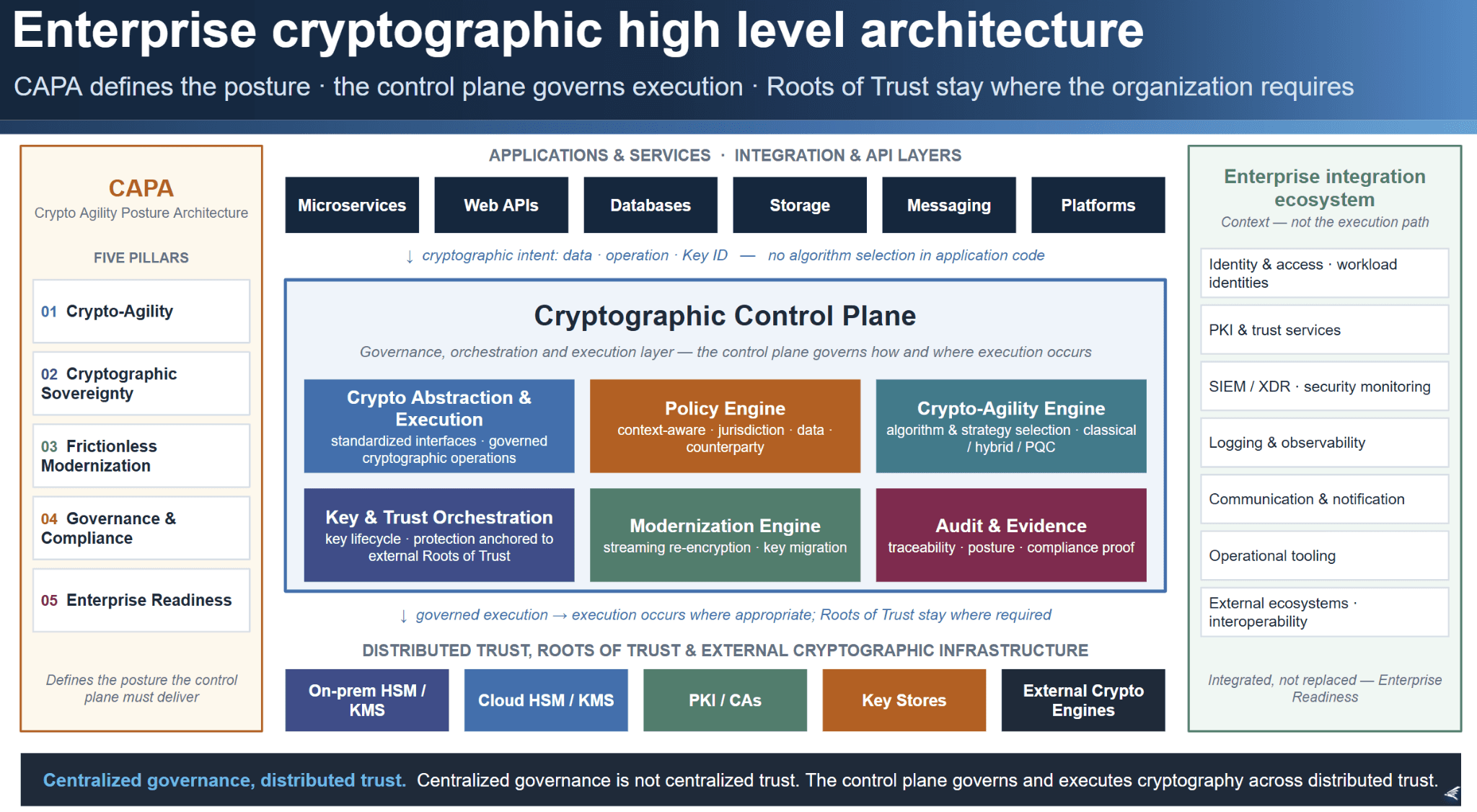
9.1 The layers of the enterprise cryptographic stack
The Enterprise Cryptographic Stack includes both the layers involved in cryptographic operations and the surrounding capabilities that define posture and provide enterprise context. Not every component participates directly in the cryptographic execution path: CAPA defines the posture the architecture is intended to support, while the Enterprise Integration Ecosystem provides identity, trust, security, observability, operational, and interoperability context.
Applications and Services
At the top of the stack are the applications, services, and systems that process business data. These systems require cryptographic capabilities for data encryption, digital signatures, application-level integrity and confidentiality, identity-related operations, and secure data storage. Historically, many of these cryptographic operations have been implemented directly within application code. In a Control Plane architecture, governed applications instead express cryptographic intent without embedding algorithm-specific implementation decisions.
Integration and API Layers
Modern enterprise systems interact through APIs, messaging platforms, middleware, service integration layers, and external interfaces. These integration mechanisms frequently rely on application-level cryptographic capabilities for data confidentiality, message integrity, digital signatures, identity-related operations, and protected data exchange. They may also need to interoperate with external organizations or ecosystems that impose specific protocols, formats, standards, or cryptographic requirements.
The Cryptographic Control Plane
The Cryptographic Control Plane provides the governance and orchestration layer of the enterprise cryptographic architecture. Applications and systems express cryptographic intent, while the Control Plane evaluates that intent against the applicable policy and context and determines how the required cryptographic capability should be fulfilled.
Its responsibilities may include cryptographic policy enforcement, algorithm and security-strategy selection, key and trust orchestration, lifecycle management, cryptographic modernization, interoperability decisions, and coordination across distributed trust domains. The Control Plane centralizes governance without requiring cryptographic execution or key custody to be centralized. This does not imply that cryptographic execution occurs exclusively outside the Control Plane. A Control Plane may execute cryptographic operations directly through its own cryptographic engines while relying on external HSMs, KMS platforms, or other trust infrastructure for key protection, Root of Trust, or operations that must remain within those external trust boundaries.
These responsibilities can be understood through several complementary capability areas: cryptographic abstraction, policy evaluation, crypto-agility, key and trust orchestration, modernization of existing cryptographic protection, and audit and evidence. These are architectural responsibilities rather than a prescribed product decomposition; implementations may organize and deliver them differently.
Enterprise Integration Ecosystem
The Cryptographic Control Plane does not operate as an isolated security system. It must participate in the enterprise technology ecosystem that already governs identity, security operations, observability, trust, communications, and operational processes.
Depending on the environment, this ecosystem may include identity and access infrastructure, workload and machine identity systems, PKI and trust services, security monitoring platforms, SIEM and XDR capabilities, logging and observability platforms, communication and notification services, operational tooling, and external systems with which cryptographic interoperability is required.
These integrations are not necessarily part of the cryptographic execution path. They provide the surrounding enterprise context through which identity, authorization, monitoring, evidence, alerting, operational control, and interoperability become part of governed cryptographic operations.
Some enterprise capabilities may participate in different roles depending on the cryptographic operation. PKI is a common example: certificate lifecycle, trust services, and validation may provide surrounding enterprise capabilities, while certificates, trust chains, and certificate authorities may also participate directly in cryptographic trust relationships. Their placement therefore depends on the role they perform in a particular context rather than on a rigid architectural boundary.
Distributed Cryptographic Trust and Execution Infrastructure
Cryptographic execution relies on the key, trust, and cryptographic infrastructures selected by the organization. These may include multiple HSMs, cloud KMS platforms, on-premises key management systems, PKI and certificate authorities, certificate lifecycle and validation services, secure key stores, cryptographic engines, and other digital trust services.
These infrastructures perform complementary functions. HSMs, KMS platforms, key stores, and cryptographic engines provide key protection and cryptographic execution capabilities, while PKI and related digital trust services establish and maintain identity-to-key bindings, certificate chains, validation status, and other trust relationships. The Cryptographic Control Plane may consume and integrate with these capabilities where required by application and data cryptography without replacing the specialized infrastructure that provides them.
These infrastructures may coexist across providers, business units, regions, jurisdictions, or independent trust domains. The Cryptographic Control Plane does not require them to be consolidated into a single platform. Instead, it coordinates how the relevant capabilities participate in governed cryptographic operations according to policy, security, sovereignty, resilience, interoperability, and operational requirements.
Hardware and Trusted Execution
Within or beneath these trust and execution infrastructures, hardware and trusted execution technologies may provide additional foundational security guarantees. These technologies are not represented as a separate layer in the high-level architecture because they may be embedded within HSMs, cryptographic engines, platforms, or other trust infrastructure.
These include secure hardware modules, trusted platform modules (TPM), secure enclaves and trusted execution environments, and hardware-based random number generators.
Different trust domains may rely on different hardware or trusted execution technologies, reinforcing the distinction between common governance and distributed execution.
9.2 Positioning the control plane within the stack
The Cryptographic Control Plane does not replace existing cryptographic or enterprise infrastructure. It provides a governance and orchestration layer across it. CAPA defines the cryptographic posture that this architecture is intended to sustain, while the Control Plane coordinates how that posture is implemented across governed applications, enterprise integrations, and distributed cryptographic trust and execution infrastructure. Applications interact with the Control Plane through standardized interfaces, while the Control Plane coordinates policy, cryptographic strategy, trust infrastructure, lifecycle decisions, and enterprise integrations according to context.
This architecture deliberately separates governance from custody and execution. An organization may govern cryptographic behavior consistently across the enterprise while keys and cryptographic operations remain distributed across multiple HSMs, KMS platforms, providers, trust domains, and jurisdictions. Similarly, the Control Plane integrates with existing identity, security, observability, and operational platforms rather than requiring parallel enterprise infrastructure.
This separation provides several advantages:
- Applications are decoupled from cryptographic implementation decisions
- Cryptographic policy can be governed consistently across systems and trust domains
- Keys and Roots of Trust can remain distributed according to sovereignty, resilience, jurisdictional, and operational requirements
- Algorithm and lifecycle transitions can be coordinated without requiring application-specific implementations
- Existing HSM, KMS, PKI, identity, security, and observability investments can continue to participate in the architecture
- External interoperability requirements can be satisfied without defining the entire internal cryptographic posture
- Enterprise governance can evolve without forcing infrastructure consolidation
9.3 Enabling governed cryptographic infrastructure
The Enterprise Cryptographic Stack illustrates that governed cryptography is not created by replacing the enterprise's existing cryptographic infrastructure with a single centralized system. It emerges by introducing a governance layer capable of coordinating cryptographic behavior across applications, distributed trust infrastructure, enterprise services, and external ecosystems.
This architecture allows organizations to preserve heterogeneous HSMs, KMS platforms, trust domains, identity systems, security operations tooling, and deployment models while establishing a common cryptographic posture across them. Centralized governance therefore becomes compatible with distributed trust, organizational sovereignty, operational resilience, and enterprise heterogeneity.
The Cryptographic Control Plane becomes the coordination point through which the capabilities defined by CAPA can be operationalized across governed systems and the surrounding enterprise environment: cryptographic strategies can evolve without application change, trust and authority remain under organizational control, existing cryptographic protection can be modernized, policy and compliance requirements can be enforced according to context, and cryptographic infrastructure can integrate naturally with the surrounding enterprise ecosystem.
The next chapter examines how organizations can progressively transition toward this architecture without requiring a disruptive replacement of their existing systems or trust infrastructure.
Chapter 10Migration Path Toward the Cryptographic Control Plane
Transitioning toward a Cryptographic Control Plane does not require organizations to redesign or replace their entire existing technology landscape. Enterprise environments are complex, heterogeneous, and often composed of systems developed over many years. Attempting to replace cryptographic implementations across all systems simultaneously would be operationally unrealistic.
Instead, organizations advance through a structured migration path that operates on three parallel tracks from the very first day. The first track — greenfield — addresses all new systems and applications. These adopt decoupled cryptographic architecture immediately, without waiting for any legacy work to be completed. The second track — brownfield critical — addresses the five to ten most critical applications in the organization. These are identified immediately, analyzed in depth, and prepared for migration in parallel with the deployment of the Control Plane infrastructure — without waiting for a complete landscape inventory. The third track — brownfield general — addresses the remaining legacy landscape through a comprehensive inventory and phased migration roadmap. All three tracks run simultaneously. The greenfield track stops the accumulation of new cryptographic debt from day one. The brownfield critical track delivers the highest-impact migrations first. The brownfield general track systematically resolves the remaining debt over time. Together, they define the complete migration path toward a Cryptographic Control Plane.
Migration toward governed cryptography does not require the simultaneous consolidation of existing cryptographic infrastructure. Applications and data domains can progressively come under Control Plane governance while continuing to use existing HSMs, KMS platforms, key hierarchies, providers, and trust domains where appropriate. The objective is to progressively converge cryptographic governance, not to impose infrastructure uniformity.
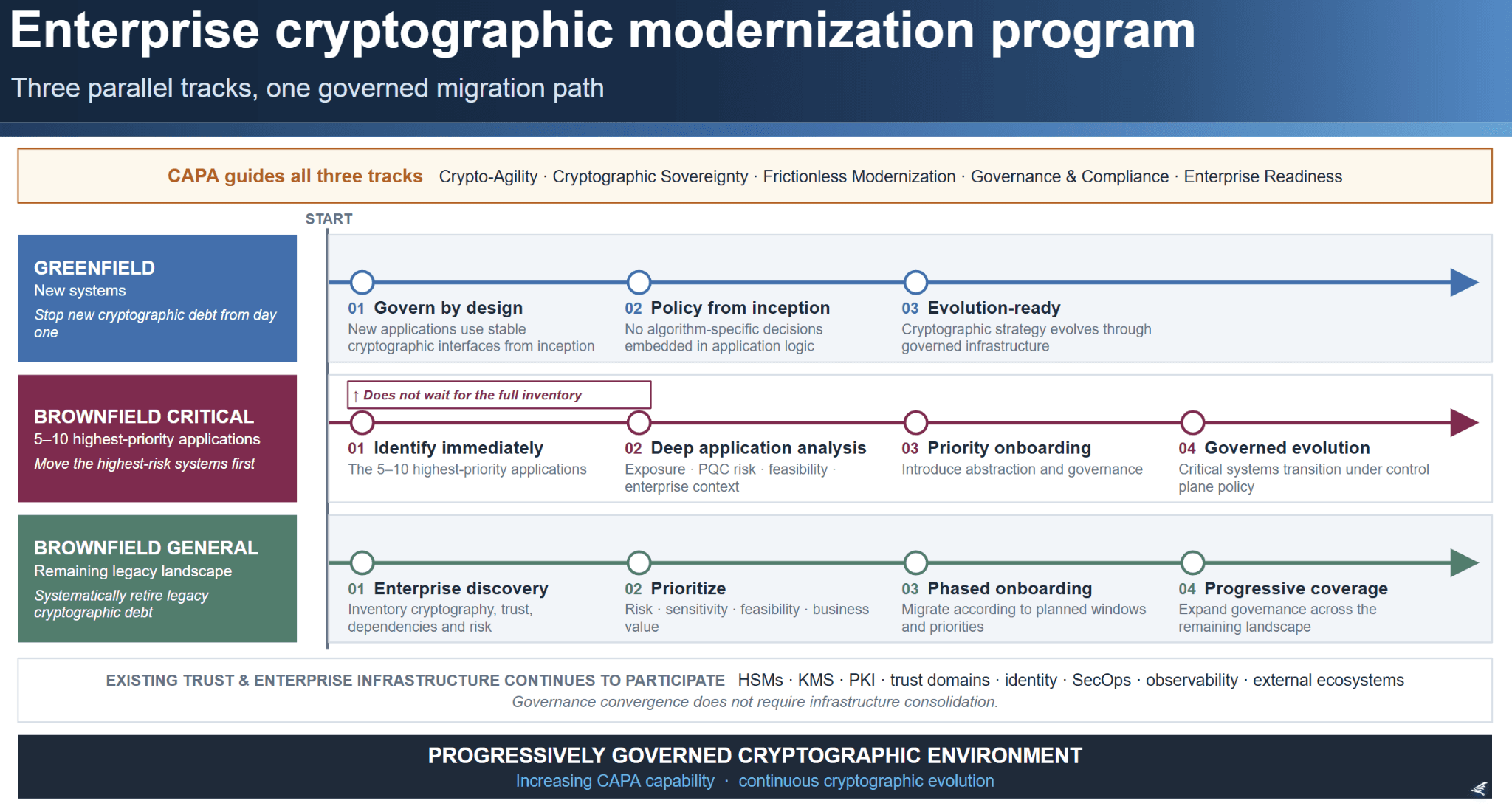
10.1 Discovery: understanding the cryptographic landscape
The first activity toward governed cryptographic infrastructure operates on two simultaneous fronts. The first is a comprehensive inventory of the full cryptographic landscape — mapping how cryptography is currently used, governed, and supported across systems, applications, trust infrastructure, providers, and enterprise environments. The second, running in parallel from the same starting point, is the identification and deep analysis of the five to ten most critical applications in the organization. These two fronts do not depend on each other: the critical application analysis can begin immediately using organizational knowledge of which systems handle the most sensitive data, process the highest transaction volumes, or carry the greatest regulatory exposure — before the comprehensive inventory is complete.
This stage typically involves:
- Identifying where cryptographic algorithms and mechanisms are used
- Mapping dependencies on specific cryptographic libraries and implementations
- Cataloging key management mechanisms, HSMs, KMS platforms, certificate and trust services, and other cryptographic infrastructure
- Mapping where keys and Roots of Trust reside across providers, environments, regions, jurisdictions, and organizational trust domains
- Identifying cryptographic protocols, representation formats and profiles, and external interoperability requirements
- Identifying the cryptographic policies, regulatory requirements, and jurisdictional constraints applicable to systems and data
- Evaluating exposure to vulnerable, deprecated, or non-compliant cryptographic mechanisms
- Identifying dependencies on enterprise identity, security operations, observability, and operational infrastructure relevant to cryptographic governance
This discovery phase enables organizations to understand not only where cryptography is used, but also the broader structure of their existing cryptographic posture: how algorithms are implemented, where cryptographic trust resides, which key and trust infrastructures are involved, what policies and jurisdictional requirements apply, which external dependencies must be preserved, and where cryptographic risk or technical debt is concentrated. It also helps identify systems with long-term confidentiality requirements that may require early migration toward quantum-resistant protections. Critically, the discovery phase should also produce a greenfield policy decision: a formal organizational commitment, made with executive sponsorship, that new systems will not embed application-level cryptographic decisions that should evolve independently from application code, but will instead consume governed cryptographic capabilities through appropriate abstraction interfaces. This policy does not depend on completing the brownfield migration — it can and should be established immediately as a parallel action. The discovery inventory defines the scope of the brownfield problem. The greenfield policy prevents that problem from growing.
10.2 Critical application analysis: preparing priority migrations
Not all systems require equal preparation before migration to the Control Plane. The five to ten applications identified as highest priority — based on the sensitivity of the data they protect, their regulatory exposure, their transaction volume, or the longevity of the confidentiality requirements they serve — warrant a structured and detailed analysis before their migration begins. This analysis can proceed immediately, using organizational knowledge of which systems are most critical, without waiting for the comprehensive landscape inventory to be complete.
The purpose of this analysis is to understand the specific cryptographic profile of each critical application, assess its PQC risk exposure, evaluate the feasibility of its migration, and identify the technical, trust, governance, interoperability, and operational dependencies that will shape the migration approach.
The following questions provide the analytical framework for this assessment, organized across four dimensions.
Cryptographic exposure. This dimension maps what the application does cryptographically, where those operations live, and which cryptographic representations or formats the application produces, consumes, or persists.
Post-quantum risk. This dimension evaluates the specific PQC exposure of the application and the urgency of its migration.
Migration feasibility. This dimension assesses how the application can be migrated and what constraints must be managed.
Governance and enterprise context. This dimension maps the organizational and operational context in which the application's cryptography operates, including applicable policies and regulatory requirements, key and trust infrastructure dependencies, jurisdictional constraints, identity and access dependencies, external interoperability requirements, and relevant security or operational integrations.
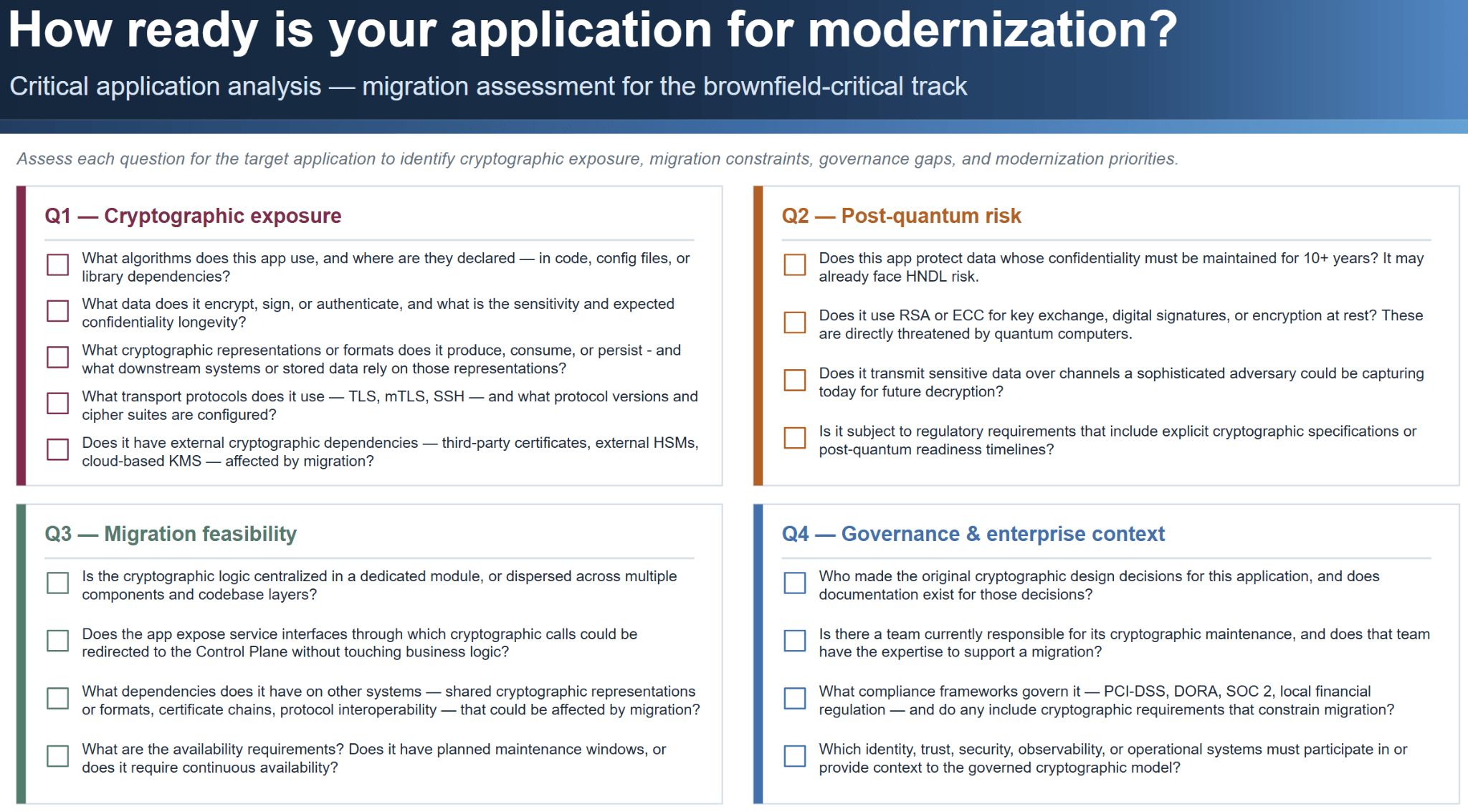
The output of this analysis for each critical application is a migration profile: a structured document that captures its cryptographic exposure, PQC risk level, migration feasibility constraints, governance and enterprise context, and the recommended approach for onboarding it to the Control Plane. The profile should identify not only the application changes required for onboarding, but also the cryptographic policies, trust infrastructure, representation and interoperability requirements, and enterprise integrations that must be preserved or introduced during migration. These migration profiles become the execution plan for the brownfield critical track, and their preparation in parallel with Control Plane deployment ensures that high-priority migrations can begin immediately once the infrastructure is operational.
10.3 Abstraction: reducing direct cryptographic dependencies
Once the cryptographic landscape is understood, organizations can begin introducing abstraction layers that reduce the direct coupling between application code and cryptographic implementations. This stage applies differently to the two tracks. For the greenfield track, abstraction is not a future phase — it is an immediate condition. Every new application is built from the outset to consume governed cryptographic services through stable interfaces, without embedding direct algorithm selection, cryptographic library dependencies, or algorithm-specific representation handling in application code. For the brownfield track, abstraction is introduced progressively. This typically includes introducing cryptographic service interfaces into existing systems during planned maintenance cycles, centralizing cryptographic operations through APIs or services as systems are refactored, and reducing direct library dependencies incrementally as each system is onboarded to the control plane.
The goal for both tracks is the same: applications express cryptographic intent rather than directly invoking specific cryptographic implementations. As systems are onboarded, this abstraction reduces application-level dependencies on specific algorithms, libraries, cryptographic execution mechanisms, and algorithm-specific representation formats, allowing the Cryptographic Control Plane to govern how cryptographic intent is fulfilled according to policy and context.
10.4 Orchestration: introducing cryptographic governance
After abstraction mechanisms are established, organizations can begin introducing orchestration capabilities that govern cryptographic behavior across onboarded systems. This stage introduces centralized cryptographic policy enforcement, algorithm and security-strategy lifecycle management, support for classical, hybrid, and post-quantum cryptographic deployments, governed cryptographic execution across internal and external cryptographic infrastructure, and governed cryptographic transitions across systems and environments.
As orchestration expands, cryptographic decisions can increasingly be evaluated according to policy and context, including the operation being performed, the data involved, the applicable security or regulatory requirements, the trust infrastructure that may participate, jurisdictional constraints, and external interoperability requirements. The Control Plane provides common governance across these environments while Roots of Trust remain where the organization requires and cryptographic execution occurs in the domain appropriate to the operation, policy, key architecture, and trust model.
At this stage, cryptographic behavior increasingly becomes governed by infrastructure rather than individual application implementations. The Cryptographic Control Plane therefore begins to emerge as a functional architectural layer, governing cryptographic policy, lifecycle, trust, and execution across an expanding portion of the enterprise environment.
10.5 Continuous cryptographic evolution
As orchestration capabilities mature and expand across governed systems, organizations gain the ability to manage an increasing portion of cryptographic evolution as an ongoing infrastructure process. This includes gradual migration between classical, hybrid, and post-quantum strategies, policy-driven cryptographic updates, coordinated algorithm and key lifecycle transitions, response to cryptographic vulnerabilities, modernization of existing protected data, and adaptation to changing regulatory, jurisdictional, trust, interoperability, and enterprise requirements.
Rather than treating every cryptographic change as a disruptive system-wide migration, organizations can progressively absorb change through established governance, lifecycle, and modernization mechanisms. As these capabilities expand across the enterprise and become embedded in normal operational practice, the organization moves toward the continuous cryptographic evolution described at the highest levels of the CAPA Cryptographic Maturity Model.
10.6 Aligning migration with CAPA
The migration path toward a Cryptographic Control Plane provides a practical mechanism for progressively developing the capabilities defined by CAPA. These capabilities should not be interpreted as sequential stages that appear only after a particular maturity level is reached. Crypto-Agility, Cryptographic Sovereignty, Frictionless Modernization, Cryptographic Governance & Compliance, and Enterprise Readiness can begin to be developed from the organization's current state and become increasingly operational as systems are onboarded to governed cryptographic infrastructure.
The three migration tracks contribute to this progression in different ways. The greenfield track prevents new cryptographic dependencies from being embedded in application code and allows new systems to adopt governed cryptographic services from the beginning. The brownfield critical track applies CAPA capabilities first to systems where cryptographic risk, data sensitivity, regulatory exposure, or operational importance creates the greatest need. The brownfield general track progressively extends those capabilities across the remaining legacy landscape according to risk, feasibility, and business priorities.
Across these tracks, CAPA provides the posture that guides migration decisions. Crypto-Agility reduces application dependency on specific cryptographic mechanisms and their algorithm-specific representations. Cryptographic Sovereignty ensures that migration preserves organizational control over trust, choice, and authority without requiring unnecessary consolidation of existing trust infrastructure. Frictionless Modernization enables existing protected data and cryptographic assets to evolve independently from the applications that originally created them. Cryptographic Governance & Compliance translates applicable requirements into enforceable policy and evidence. Enterprise Readiness ensures that the evolving cryptographic architecture continues to integrate with the heterogeneous identity, trust, security, observability, operational, and external ecosystems already present in the enterprise.
Migration toward the Control Plane is therefore not only a technical exercise in application abstraction. It is the progressive establishment of a governed cryptographic posture across an expanding portion of the enterprise. Greenfield and brownfield environments may advance at different rates, and existing HSMs, KMS platforms, providers, and trust domains may remain heterogeneous throughout that process. The objective is governance convergence and increasing CAPA capability, not infrastructure uniformity.
10.7 Preparing for the post-quantum transition
The transition toward post-quantum cryptography represents one of the most significant cryptographic migrations organizations will face in the coming decades. Organizations that establish a cryptographic control plane before this transition reaches large-scale deployment will be significantly better positioned to adapt to the emerging cryptographic landscape.
For systems governed through the Cryptographic Control Plane, transitions between classical, hybrid, and post-quantum cryptographic strategies can increasingly be managed through infrastructure governance mechanisms rather than repeated application-level algorithm changes. Legacy systems not yet onboarded may still require application-specific migration work, which is why the greenfield, brownfield critical, and brownfield general tracks proceed in parallel. As Control Plane coverage expands, the portion of the cryptographic landscape that can evolve through governed policy and lifecycle mechanisms expands with it, significantly reducing the operational risk of the post-quantum transition and future cryptographic change.
10.8 From architectural model to operational implementation
While the Cryptographic Control Plane represents an architectural model, organizations ultimately require operational technologies capable of implementing these capabilities in real-world enterprise environments. Such technologies must provide the infrastructure services required to abstract cryptographic implementation from applications, enforce cryptographic policy, execute cryptographic operations directly where appropriate, coordinate execution across external cryptographic infrastructure, and orchestrate cryptographic lifecycle transitions, coordinate across heterogeneous key and trust infrastructure, support modernization of existing cryptographic protection, and integrate with the broader enterprise technology ecosystem.
Operational implementation must preserve the architectural principles established throughout this paper: centralized governance does not require centralized trust, existing cryptographic infrastructure may continue to participate according to policy and context, and migration can proceed progressively across greenfield and brownfield environments. The next chapter examines how the Cryptographic Control Plane and CAPA capabilities can be operationalized in practice.
Chapter 11Operationalizing the Architecture
The Cryptographic Control Plane described in this paper represents an architectural model for governing cryptographic behavior across enterprise environments. Realizing this architecture in practice requires operational technologies capable of abstracting cryptographic implementation from applications, enforcing cryptographic policy, coordinating lifecycle transitions and modernization, operating across heterogeneous key and trust infrastructure, and integrating cryptographic governance with the broader enterprise technology ecosystem.
These technologies operationalize the Control Plane by connecting application cryptographic intent with governed policy, cryptographic execution, distributed trust infrastructure, and the enterprise services that provide identity, security, observability, and operational context. The objective is not to replace the existing cryptographic or enterprise infrastructure, but to introduce a governance, orchestration, and cryptographic execution layer that can operate across and integrate with it.
11.1 Implementing the control plane
To operationalize a cryptographic control plane, organizations require infrastructure capable of performing several key functions, including:
- Providing standardized interfaces through which applications can express cryptographic intent
- Abstracting cryptographic algorithms, mechanisms, and implementation decisions from governed applications
- Evaluating and enforcing context-aware cryptographic policies across systems and environments
- Orchestrating algorithm, key, and cryptographic lifecycle transitions
- Executing cryptographic operations directly where appropriate and coordinating operations across heterogeneous and distributed HSMs, KMS platforms, key stores, and external cryptographic infrastructure
- Supporting classical, hybrid, and post-quantum cryptographic strategies
- Enabling modernization of existing cryptographic protection without requiring originating applications to recreate protected data
- Integrating with enterprise identity, security operations, observability, trust, communication, and operational infrastructure
- Supporting interoperability with external systems and cryptographic ecosystems
- Providing visibility, traceability, and evidence of cryptographic policy enforcement
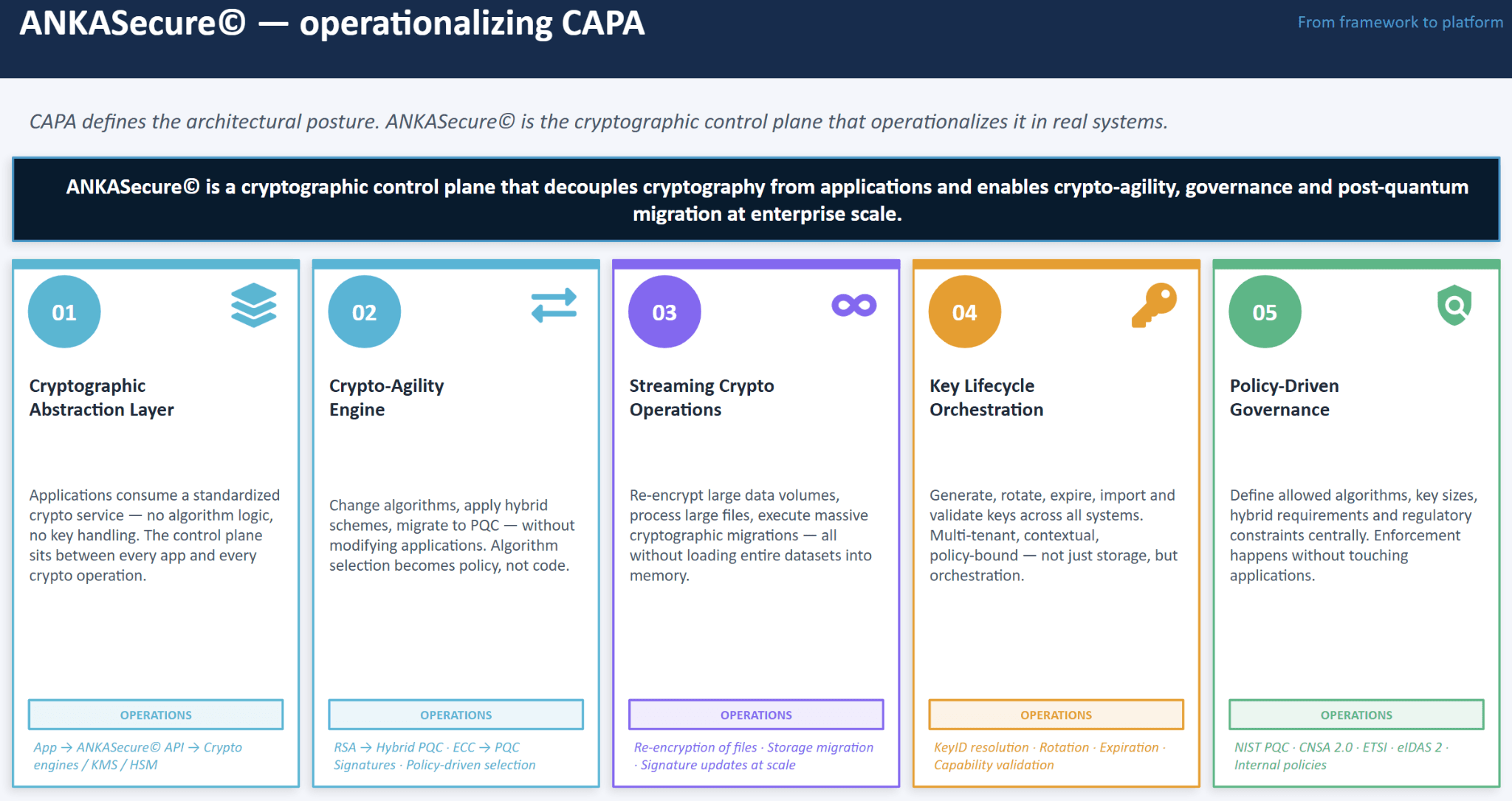
By providing these capabilities through governed infrastructure services, technologies implementing the Cryptographic Control Plane allow organizations to progressively move cryptographic decision-making out of individual applications and into a common governance layer. As applications are onboarded, cryptographic strategies, policies, trust dependencies, and lifecycle transitions can increasingly evolve without requiring application-specific implementations for each change, while cryptographic execution and Roots of Trust remain distributed where organizational requirements dictate.
11.2 CAPA as an operational framework
CAPA - Crypto Agility Posture Architecture defines the foundational capabilities required to establish and sustain a governed cryptographic posture. As described in Chapter 7, these capabilities are organized around five complementary pillars: Crypto-Agility, Cryptographic Sovereignty, Frictionless Modernization, Cryptographic Governance & Compliance, and Enterprise Readiness.
Operationalizing CAPA requires more than implementing individual cryptographic functions. Organizations need the ability to evolve cryptographic strategies without repeated application change, retain control over cryptographic trust, choice, and authority, modernize existing cryptographic protection, translate requirements into enforceable policy and verifiable evidence, and integrate cryptographic governance with the heterogeneous enterprise environments in which those capabilities must operate.
The Cryptographic Control Plane provides an architectural model through which these capabilities can be exercised across governed systems. CAPA defines the posture and capabilities the organization seeks to establish; the Control Plane provides the governance and orchestration architecture through which those capabilities can become operational. The relationship is complementary rather than one-to-one: individual Control Plane functions may support multiple CAPA pillars, and each CAPA pillar may depend on multiple operational capabilities.
11.3 ANKASecure© as an implementation of the Cryptographic Control Plane
ANKASecure© is an implementation of the Cryptographic Control Plane architecture described in this paper. Through standardized APIs and service interfaces, the platform separates application cryptographic intent from the mechanisms used to execute it, allowing cryptographic behavior to be governed through infrastructure rather than embedded directly within application code. ANKASecure© provides operational capabilities for policy enforcement, algorithm and key lifecycle management, cryptographic execution, modernization, and integration with existing cryptographic infrastructure. These capabilities provide a practical mechanism through which organizations can develop the cryptographic posture defined by CAPA.
The architecture of ANKASecure© is organized as a layered stack in which applications express cryptographic operations using key identifiers rather than embedding algorithm selection in application logic. The Control Plane resolves the relevant key metadata, policy, lifecycle state, and cryptographic mechanism required to fulfill the operation, then executes or coordinates the cryptographic operation in the appropriate execution domain. Depending on the operation and trust model, execution may occur within ANKASecure© itself or through an external HSM, KMS, or cryptographic engine. This indirection decouples governed applications from direct algorithm selection and enables cryptographic behavior to evolve independently from application release cycles.
ANKASecure© also abstracts the representation of cryptographic outputs across heterogeneous cryptographic mechanisms. For modern API-based interactions, the platform uses representation structures based on the JOSE family of formats, including JWE and JWS, while supporting cryptographic mechanisms that may extend beyond those natively defined by standard JOSE algorithm registries. This provides governed applications with a consistent representation model even as the underlying cryptographic strategy changes.
This representation model should not be interpreted as universal JOSE interoperability. External implementations can process a representation only when they support the relevant algorithms, identifiers, parameters, profiles, and extensions used by the operation. Where external interoperability requires a specific standard representation or profile, ANKASecure© can treat that requirement as part of the governed interoperability context.
The ANKASecure© architectural stack
The platform is structured around three layers that progressively separate cryptographic intent from cryptographic execution:
- Enterprise Applications form the top of the stack. Applications invoke cryptographic operations using key identifiers rather than selecting algorithms directly. Cryptographic algorithm selection, lifecycle state, and applicable policy are resolved by the Control Plane rather than implemented independently by each application. This design reduces application-level cryptographic coupling and helps prevent the proliferation of independently governed cryptographic implementations.
- The ANKASecure© Control Plane sits at the center of the architecture and constitutes the governance and orchestration layer. It receives cryptographic requests through its service interfaces, evaluates them according to applicable policy and lifecycle state, coordinates cryptographic execution, and returns the resulting output. Changes to governed cryptographic policy can therefore affect subsequent operations without requiring applications to embed the corresponding cryptographic decision or undergo an application release solely to change that decision.
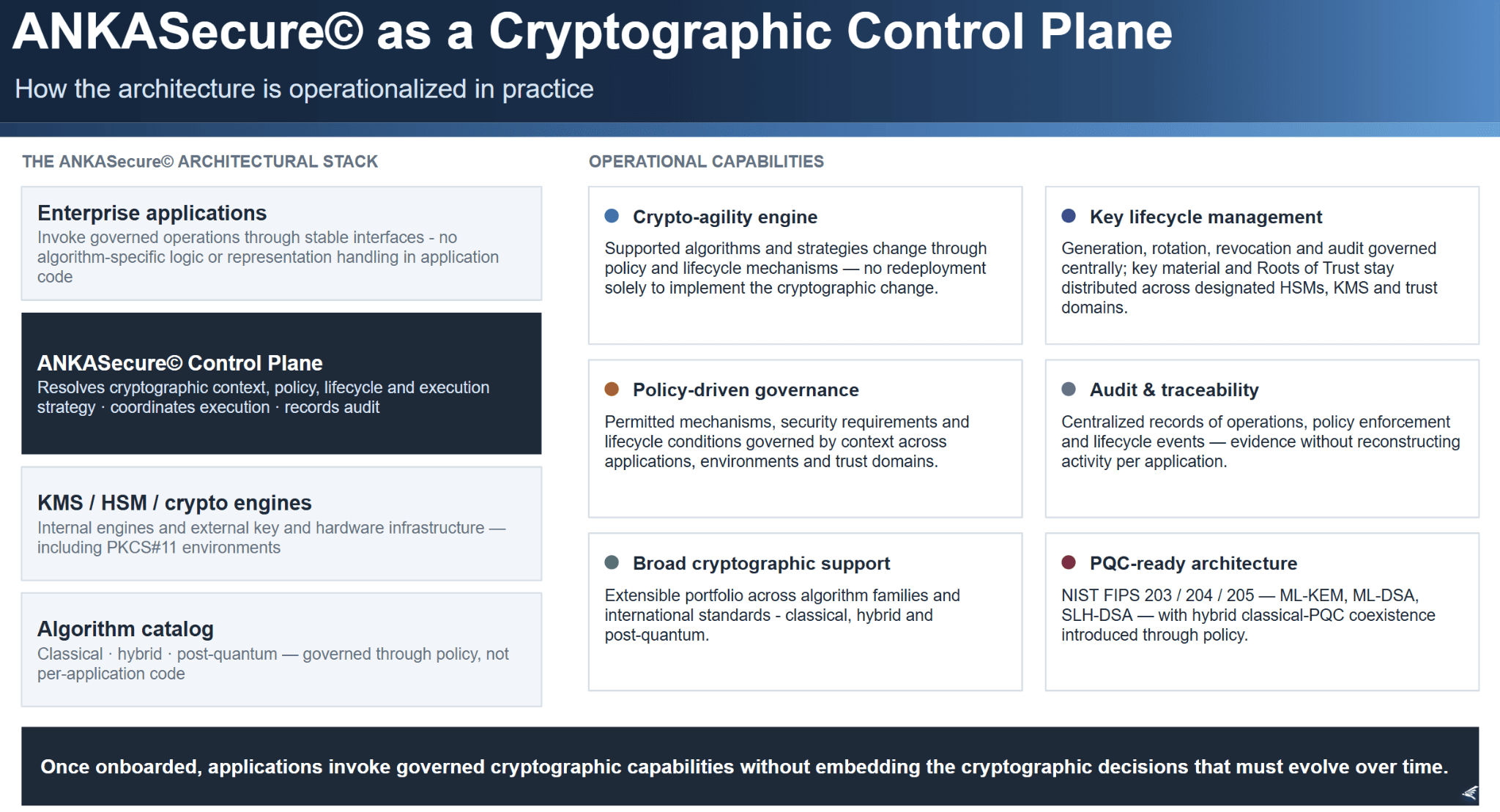
- The KMS / HSM / External Crypto Infrastructure layer provides external key protection, Roots of Trust, custody, and cryptographic execution capabilities where required by the applicable trust model. ANKASecure© can perform cryptographic operations through its own cryptographic engines while integrating with external HSMs, KMS platforms, and PKCS#11 environments for key protection, trust anchoring, or operations that must remain within those infrastructures. This allows governance to remain centralized while key protection, custody, Roots of Trust, and execution domains remain aligned with organizational requirements.
- In this model, centralized key lifecycle management does not imply that ANKASecure© becomes the ultimate Root of Trust. Supported key material may be generated, managed, and used by ANKASecure© while its protection is anchored to cryptographic infrastructure controlled by the organization, such as an HSM or KMS. The organization can therefore retain control of the Root of Trust while allowing the Control Plane to perform governed cryptographic operations.
Operational capabilities
ANKASecure© exposes a set of operational capabilities through which the Cryptographic Control Plane architecture is implemented in practice. These capabilities collectively support the cryptographic posture defined by CAPA, but they should not be interpreted as a one-to-one mapping to individual CAPA pillars. Each operational capability may contribute to multiple pillars, while each pillar may depend on several platform capabilities working together.
| Crypto-agility engine For applications governed through ANKASecure©, supported cryptographic algorithms and strategies can be changed through policy and lifecycle mechanisms without requiring an application redeployment solely to implement the cryptographic change. Transitions that would otherwise require coordinated application-level engineering can increasingly become governed infrastructure operations. | Key lifecycle management ANKASecure© provides centralized governance of supported key lifecycle operations, including generation, rotation, revocation, and audit, according to policy and the capabilities of the underlying key infrastructure. Key material and Roots of Trust may remain distributed across designated HSMs, KMS platforms, and trust domains, allowing lifecycle governance to be centralized without requiring key custody to be centralized. |
|---|---|
| Policy-driven governance Cryptographic policies provide centralized governance over supported cryptographic behavior across systems onboarded to ANKASecure©. Policies can govern permitted mechanisms, security requirements, lifecycle conditions, and other cryptographic decisions according to the context supported by the platform. This allows the organization to maintain coordinated governance while supporting different cryptographic requirements across applications, environments, trust domains, and operational contexts. | Audit & traceability Cryptographic operations performed through ANKASecure© generate centralized audit and traceability records that provide visibility into governed cryptographic activity. These records can provide evidence of cryptographic operations, policy enforcement, and lifecycle events within the scope managed by the Control Plane, reducing the need to reconstruct cryptographic activity independently across each onboarded application. |
| Broad Cryptographic Support ANKASecure© supports a broad and extensible portfolio of cryptographic mechanisms spanning multiple algorithm families, security strategies, and international standards, including classical, hybrid, and post-quantum cryptography. This breadth allows organizations to support different cryptographic requirements and evolve their cryptographic posture as algorithms, standards, interoperability requirements, and threat models change. | PQC-ready architecture Full support for NIST FIPS 203/204/205, including ML-KEM, ML-DSA, and SLH-DSA, with hybrid classical-PQC coexistence. For applications governed through ANKASecure©, supported post-quantum and hybrid strategies can be introduced through platform policy and lifecycle mechanisms without requiring the application to implement the underlying algorithm transition directly. |
This architecture allows organizations to evolve their cryptographic environments while preserving existing systems and infrastructure where appropriate. ANKASecure© does not require enterprise-wide application refactoring or cryptographic infrastructure replacement as a precondition for adoption. Greenfield systems can integrate with governed cryptographic services from the outset, while existing applications can be onboarded progressively according to risk, feasibility, and business priorities. Once governed through the Control Plane, applications can benefit from cryptographic policy, lifecycle management, and algorithm evolution without requiring repeated application changes for each subsequent cryptographic transition.
11.4 Governed execution across distributed trust infrastructure
The emergence of the Cryptographic Control Plane represents an important step in the evolution of enterprise cryptography. By introducing a common governance, orchestration, and cryptographic execution layer across applications, cryptographic services, and heterogeneous trust infrastructure, organizations can progressively move beyond fragmented cryptographic implementations toward governed cryptographic infrastructure.
The Control Plane governs cryptographic execution without requiring all cryptographic operations to occur within a single execution domain. It can execute cryptographic operations directly while also coordinating operations performed by external HSMs, KMS platforms, or specialized cryptographic infrastructure according to policy, key architecture, and trust requirements.
HSMs, KMS platforms, Roots of Trust, providers, environments, and cryptographic mechanisms may therefore remain distributed according to organizational, security, operational, and jurisdictional requirements. The Control Plane provides a common governance layer across these environments, enabling centralized governance to coexist with distributed cryptographic trust.
The result is an architectural model in which cryptography can be governed with the same strategic discipline already applied to identity, networking, and other critical enterprise infrastructure, while retaining the flexibility required for cryptographic change. As this model expands across the enterprise, the capabilities defined by CAPA can become progressively embedded in normal operations, establishing the foundation for continuous cryptographic evolution.
Chapter 12What becomes possible when cryptography is decoupled
From cryptography as embedded code — to cryptography as operational infrastructure.
The preceding chapters have described the Cryptographic Control Plane as an architectural model for governing cryptographic behavior and CAPA as the framework that defines the capabilities required for a modern cryptographic posture. Chapters 3 and 4 identified the structural limitations of embedded cryptography and the historical pattern by which critical capabilities evolve into governed infrastructure. Chapters 5 through 11 described how that transformation can be applied to enterprise cryptography and operationalized in practice.
This chapter completes that arc by addressing the question that ultimately matters to enterprise architects and security leaders: what does an organization become capable of when cryptographic decisions, lifecycle, and governance are progressively decoupled from individual application implementations?
The answer is not merely an architectural improvement. It is a set of operational capabilities that become substantially more scalable, governable, and repeatable when cryptography is treated as infrastructure: the ability to change cryptographic strategies without repeated application engineering, enforce policy across governed environments, modernize existing protected data, retain authority across distributed trust domains, operate across heterogeneous enterprise ecosystems, and ultimately absorb cryptographic change as a continuous organizational capability.
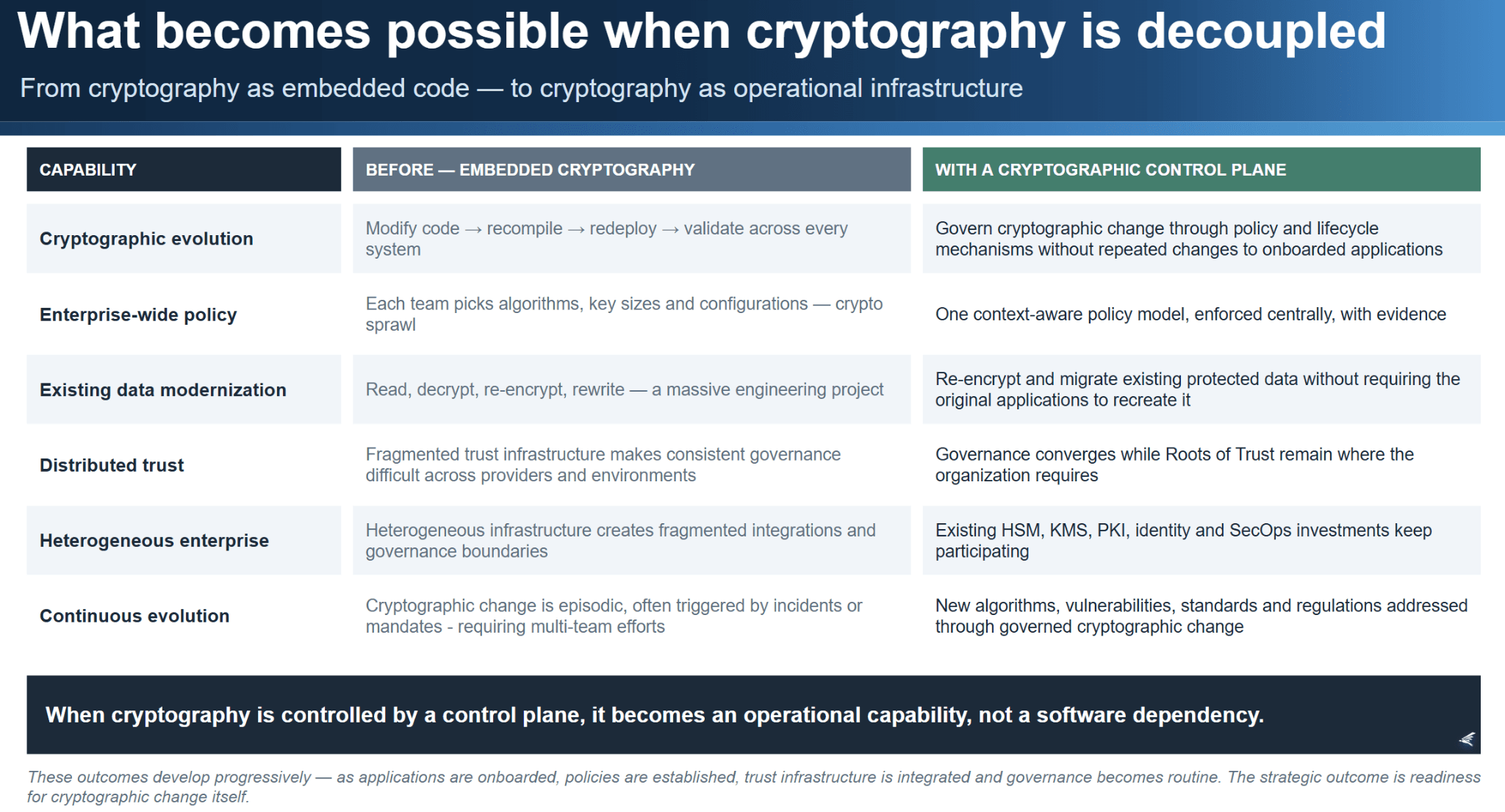
12.1 Algorithm evolution without repeated application change
In traditional architectures, changing a cryptographic algorithm often requires identifying every application that uses it, modifying cryptographic libraries or configurations, validating interoperability, testing the affected systems, and coordinating application releases. At enterprise scale, even a technically straightforward algorithm transition can therefore become a prolonged software engineering and change-management program.
Once an application is governed through a Cryptographic Control Plane, the relationship changes. The application invokes a stable cryptographic capability while supported algorithm selection, security strategy, policy, and lifecycle decisions are managed by the infrastructure beneath it. A transition from one approved mechanism to another, or from classical to hybrid or post-quantum strategies, can increasingly be executed through governed policy and lifecycle mechanisms rather than by modifying the application solely to implement the cryptographic change.
This does not eliminate the work required to onboard existing applications or address external interoperability constraints. It changes the economics of subsequent cryptographic transitions. The integration effort is performed to establish a governed architectural boundary, rather than repeated every time the cryptographic strategy evolves.
Algorithm migration without rewriting systems
| BEFORE | WITH ANKASecure© |
|---|---|
| Change RSA → modify application code → recompile → redeploy → validate compatibility across every system. | Update the cryptographic policy. ANKASecure© applies the change transparently — applications are untouched. |
This capability is not incidental. It is the primary value of the control plane model. Organizations that establish this architecture before the post-quantum transition reaches regulatory mandates will be able to adopt new standards through policy updates. Those that have not will face the same distributed engineering effort that has historically characterized every major cryptographic transition.
12.2 Centrally governed cryptographic policy across systems and environments
Traditional cryptographic governance is often fragmented across applications, libraries, infrastructure teams, security configurations, and local implementation decisions. Even when an organization defines enterprise cryptographic standards, determining whether those standards are being applied consistently can require inspecting and validating individual systems.
A Cryptographic Control Plane allows cryptographic requirements to be expressed as centrally governed policies and enforced across the systems within its scope. Central governance does not mean that every system must use the same cryptographic policy. Different policies may apply according to the data being protected, the operation being performed, the system or application involved, the applicable jurisdiction, the participating trust domains, external interoperability requirements, or other operational context.
This creates a common governance model in which cryptographic requirements can evolve centrally while their enforcement remains context-aware. It also creates a common source of visibility and traceability for governed cryptographic activity, allowing organizations to produce evidence of policy enforcement without relying exclusively on reconstruction from application-specific implementations.
Enterprise-wide cryptographic policy
| BEFORE | WITH ANKASecure© |
|---|---|
| Each development team chooses its own algorithms, key sizes, and configurations — crypto sprawl across hundreds of services. | Cryptographic policy defined once and enforced centrally across governed applications and environments, applied according to data, operation, counterparty and jurisdiction. |
The implications for regulatory compliance are significant. For systems governed through the Control Plane, demonstrating that a specific algorithm is no longer in use across the enterprise — a requirement that frequently arises in audit contexts — can be done by verifying the current policy state and the audit records of the control plane, rather than auditing each governed application individually.
12.3 Modernizing existing encrypted data without recreating it
Cryptographic modernization does not apply only to future operations. Organizations also retain large volumes of information protected under keys, algorithms, configurations, and trust infrastructure selected years earlier. That data may need to remain confidential long after the cryptographic assumptions under which it was originally protected have changed.
A Cryptographic Control Plane can provide governed mechanisms for progressively modernizing existing encrypted data without requiring the applications that originally produced it to recreate the underlying information. Depending on the protection model and available infrastructure, modernization may involve re-encryption, key rotation, migration between cryptographic mechanisms, changes to key protection or trust infrastructure, or other controlled transformations of existing protected assets.
For large data objects, streaming cryptographic operations can allow these transformations to be performed incrementally without requiring the entire dataset to be loaded into memory and without creating persistent plaintext artifacts as part of the modernization workflow. This enables organizations to address historical cryptographic dependencies progressively rather than allowing the protection of existing data to remain permanently tied to the cryptographic choices made when that data was created.
Large-scale data re-encryption
| BEFORE | WITH ANKASecure© |
|---|---|
| Migrating encrypted data requires reading, decrypting, re-encrypting and rewriting — a massive, error-prone engineering project. | Streaming re-encryption migrates entire data stores — files, databases, backups — from RSA to PQC without application changes. |
This capability is particularly relevant for organizations with long-term data retention obligations. Data encrypted today may remain in storage for a decade or more. Establishing the infrastructure capability to re-encrypt that data at scale — before quantum computing capabilities mature — is one of the most concrete and time-sensitive requirements of the post-quantum transition.
12.4 Maintaining cryptographic control across distributed trust infrastructure
Enterprise cryptographic environments rarely depend on a single trust infrastructure. Keys and Roots of Trust may reside across on-premises HSMs, cloud HSMs, cloud KMS platforms, providers, regions, jurisdictions, business units, and externally operated environments. In many cases, this distribution is deliberate, reflecting requirements for resilience, sovereignty, risk isolation, provider independence, or jurisdictional control.
A Cryptographic Control Plane allows governance to converge without requiring those trust domains to be physically consolidated. The organization can govern which cryptographic infrastructure may participate in an operation, which policies and security requirements apply, and how cryptographic capabilities are exercised while key custody and Roots of Trust remain distributed where appropriate.
This separation between governance and custody allows organizations to retain authority over cryptographic trust and choice while continuing to use heterogeneous infrastructure. When cryptographic capabilities extend beyond the organization, the same architectural principle can support governed and revocable authority rather than requiring permanent transfer of cryptographic control.
Centralized governance therefore does not have to create centralized cryptographic dependency. Organizations can establish a common control model while deliberately preserving multiple trust domains according to their security, operational, and jurisdictional requirements.
12.5 Operating across heterogeneous enterprise infrastructure
Enterprise cryptography does not operate in isolation. Cryptographic decisions depend on and interact with identity systems, HSMs and KMS platforms, PKI and trust services, security operations, observability platforms, deployment environments, communication services, operational tooling, and external systems with their own protocols and cryptographic requirements. These technologies frequently span multiple vendors, generations, deployment models, and organizational domains.
A Cryptographic Control Plane provides a common governance layer that can operate across this heterogeneous environment rather than requiring the enterprise to standardize every surrounding technology before cryptographic governance can improve. Existing investments can continue to participate where appropriate, while new integrations and providers can be introduced as the environment evolves.
This capability is particularly important in hybrid and multi-cloud environments, organizations operating across multiple jurisdictions, and mergers or acquisitions where different technology stacks and trust infrastructures must coexist. Governance can converge progressively even when the underlying enterprise landscape remains heterogeneous.
Cryptographic infrastructure therefore becomes part of the enterprise ecosystem rather than another isolated security silo. The architecture adapts to the environment in which the organization operates while preserving a consistent governance boundary above it.
12.6 Continuous cryptographic evolution
The combined effect of these capabilities is a shift from episodic cryptographic migration toward continuous cryptographic evolution. Algorithm changes, key lifecycle transitions, modernization of existing protected data, policy changes, trust infrastructure evolution, regulatory requirements, and new interoperability constraints no longer need to be treated exclusively as isolated transformation projects. They can increasingly be absorbed through established governance and operational mechanisms.
This does not mean that every cryptographic change becomes automatic or instantaneous. Significant transitions may still require risk analysis, testing, approvals, interoperability validation, staged deployment, and operational oversight. The architectural difference is that the organization develops repeatable mechanisms through which those transitions can be governed and executed rather than rebuilding the migration process for every new cryptographic event.
This is the capability represented by Level 6 of the CAPA Cryptographic Maturity Model: cryptographic change becomes part of normal organizational operations. The organization is no longer preparing only for a specific transition such as post-quantum cryptography. It has established the architectural and operational capacity to continue evolving as cryptographic threats, standards, technologies, regulations, and business requirements change.
Continuous cryptographic evolution
| BEFORE | WITH ANKASecure© |
|---|---|
| Cryptographic updates happen once every several years, forced by incidents — each one a painful multi-team effort. | Cryptography becomes adaptive. New algorithms, new vulnerabilities, new regulations — the organization responds in hours to days for governed systems. |
This is the condition that CAPA Level 6 describes: not a technology that has been installed, but a mode of operation that has become embedded in normal organizational practice. An organization at this level does not treat cryptographic evolution as a succession of exceptional engineering projects. It has established repeatable governance, lifecycle, and operational mechanisms through which supported cryptographic change can be evaluated, introduced, and managed across the governed landscape. Continuous cryptographic evolution is therefore not a single migration objective, but an organizational capability.
12.7 From possibility to readiness
These outcomes do not appear simply because a Cryptographic Control Plane has been deployed. The architecture creates the foundation, but operational capability develops progressively as applications are onboarded, policies are established, trust infrastructure is integrated, existing cryptographic assets are modernized, enterprise systems are connected, and governance becomes embedded in normal operations.
Different parts of the organization may therefore realize these outcomes at different times. Greenfield systems can adopt governed cryptographic patterns from the outset, critical brownfield systems can be prioritized according to risk and confidentiality requirements, and the remaining landscape can transition progressively as business and technical conditions allow.
CAPA provides the framework for understanding the capabilities that must mature throughout this process, while the CAPA Cryptographic Maturity Model provides a way to assess how broadly and consistently those capabilities have become operational. The Cryptographic Control Plane provides the architectural foundation through which that progression can occur.
The strategic outcome is not the completion of a single cryptographic migration. It is organizational readiness for cryptographic change itself: the ability to evolve algorithms, policies, protected data, trust infrastructure, and enterprise integrations without repeatedly rebuilding the cryptographic foundations of the systems that depend on them.
Chapter 13Conclusion
Enterprise cryptography is entering a period of fundamental transformation.
For decades, cryptographic mechanisms have been implemented primarily as embedded capabilities within individual applications. This model emerged in an era when cryptographic standards evolved slowly and algorithm transitions were infrequent.
That assumption no longer holds. Post-quantum cryptography, evolving threat models, regulatory and jurisdictional change, long-term data protection requirements, changing trust relationships, and increasingly heterogeneous enterprise environments are creating a future in which cryptographic change will be continuous rather than exceptional.
The fundamental challenge is therefore not simply selecting the next generation of cryptographic algorithms. It is establishing the organizational and architectural capability to absorb cryptographic change without repeatedly turning that change into a distributed application engineering effort.
The historical evolution of digital infrastructure provides a clear precedent. Identity, networking, and secrets management evolved from capabilities embedded within individual systems into shared infrastructure governed through common control layers.
Cryptography is now reaching the same architectural inflection point.
This architectural shift does not require cryptographic trust itself to become centralized. Roots of Trust, HSMs, KMS platforms, providers, regions, jurisdictions, and organizational trust domains may remain deliberately distributed according to security, sovereignty, resilience, and operational requirements. The objective is centralized governance without unnecessary concentration of cryptographic dependency: Centralized Governance, Distributed Trust.
As organizations progressively adopt this model, cryptographic change can increasingly be absorbed through governed infrastructure. Algorithms and security strategies can evolve without repeated application releases. Existing protected data can be modernized independently from the applications that originally created it. Regulatory and organizational requirements can become enforceable cryptographic policy. Cryptographic trust, choice, and authority can remain under organizational control. Existing enterprise technologies and external ecosystems can continue to participate without requiring the enterprise to redesign itself around a new cryptographic silo.
The post-quantum transition provides the immediate catalyst for this transformation, but it is not its destination. The algorithms standardized today will not be the final cryptographic mechanisms enterprises ever deploy. New vulnerabilities will emerge. Standards will evolve. Regulations will change. Trust relationships, providers, jurisdictions, technologies, and business requirements will continue to change with them.
Preparing for that future requires more than completing a post-quantum migration. It requires building the capability to evolve again, and again, without repeatedly rebuilding the systems that depend on cryptography.
The emergence of the Cryptographic Control Plane therefore marks a transition from static cryptographic implementation to governed cryptographic infrastructure. The long-term objective is continuous cryptographic evolution: the ability to adapt the cryptography protecting the enterprise as technology, threats, policy, trust, and business requirements change, while preserving operational continuity and organizational control.